What the Cherry Blossom Tattoo Has Meant, from the Kokinshū to Benten Kozō
2026.09.11
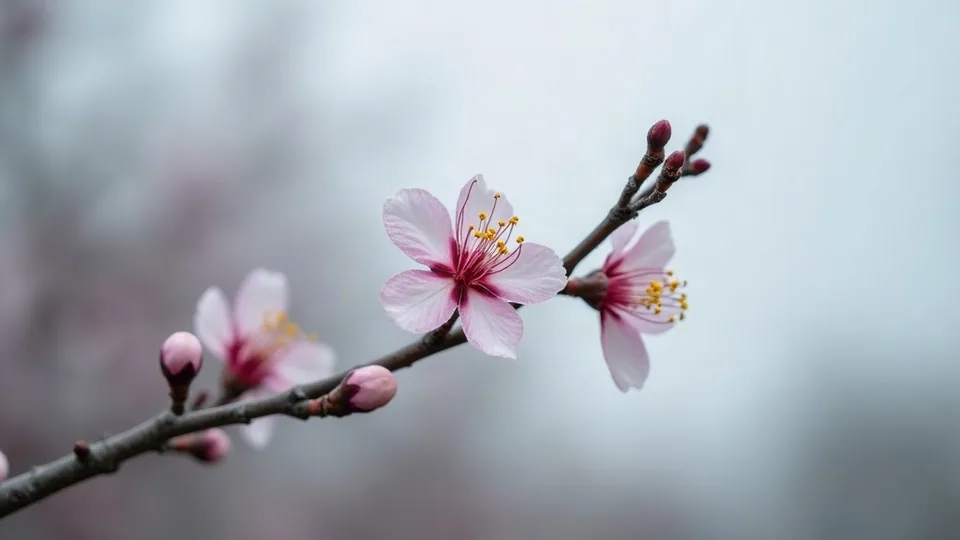
A storm of cherry blossoms in a tattoo is said to stand for a warrior's clean death. Yet the oldest example in the dictionaries of "scattering like a flower" meaning "to die cleanly" is a late-Meiji army song. The sources trace these meanings through the Kokinshū, where blossoms evoke transience and offerings; Saigyō's wish; Edo-stage tattoos, including Benten Kozō's; and modern appropriations.
The idea that "flower" means the cherry began with the Kokinshū
The cherry was not always Japan's representative flower. According to Nitō Atsushi of the National Museum of Japanese History, in the spring miscellany of book 8 of the Man'yōshū the plum has seven poems and the cherry, including the mountain cherry, six, almost level; in the spring poems of the Kokin wakashū the plum has eighteen and the cherry forty [1]. One count gives forty-one cherry poems in the whole Man'yōshū [2], and the Nihon Kokugo Daijiten notes that in the Man'yōshū the plum is second only to bush clover among plants and outnumbers the cherry [3].
Nitō quotes Motoori Norinaga's Tamakatsuma, which says that using "flower" alone to mean the cherry is not heard of up to the time of the Kokinshū, and concludes that the idea of "flower means cherry" begins with that anthology [1]. Its first book of spring holds Ariwara no Narihira's poem written on seeing the cherries at Nagisa-no-in: yo no naka ni / taete sakura no / nakariseba / haru no kokoro wa / nodokekaramashi, "if there were no cherry blossoms in this world, how tranquil our hearts would be in spring" [4]. By imagining a world without cherry blossoms, the poet expresses how deeply they unsettle him.
The record of a flower banquet is older still. The Nihon Kōki, under the second month of 812, says Emperor Saga went to the Shinsen-en garden to view the flowering trees and had literati compose poems, adding that the custom of the flower banquet began here [5]. The original, however, says only "flowering trees" and does not name the cherry. The shogun Tokugawa Yoshimune planted 1,270 cherry trees on Asukayama in 1720 and 1721 and opened it as a pleasure ground, and it became one of Edo's places for cherry viewing [6]. The cherries Edo townspeople looked at were not today's Somei-yoshino. That variety is said to have been sold late in the Edo period as "Yoshino cherry" and was named Somei-yoshino by Fujino Yoshinori in 1900; before it, cherry viewing centred on mountain cherries, higan cherries and double-flowered cherries [7, 8].
In the Heian period, falling blossoms meant transience and offering, not courage
The Kokinshū's defining poem of falling blossoms is Ki no Tomonori's: hisakata no / hikari nodokeki / haru no hi ni / shizugokoro naku / hana no chiruramu, "on this spring day of calm and tranquil light, why do the blossoms fall with restless hearts?" It is number 84 in the second book of spring, headed "on the falling of the cherry blossoms" [4]. Nitō notes that its cherry is plainly the cherry as a falling flower [1]. The poem expresses sorrow at the passage of time, with grief at the falling blossoms conveying affection for them rather than readiness for death.
Falling cherry blossoms also have associations with Buddhist sange, the scattering of flowers. Sada Kimiko defines sange as scattering flowers in offering to the buddhas, and calls poems 69 to 89 of the second book of spring a cluster of falling-cherry poems [9]. Henjō has a poem composed beneath the cherries on his way back from a relic ceremony held by the prince of Urin-in: yamakaze ni / sakura fukimaki / midarenamu / hana no magire ni / tachitomaru beku, "let the mountain wind whirl the blossoms into disarray, so that in their confusion you may stay" (Parting, 394) [4]. Sada introduces Nakano Masako's reading of this storm of petals as a vision of heavenly flowers dancing in the sutras, seen through the sange of the ceremony [9]. A storm of petals across the back can, on the evidence of the texts, be read as flowers of offering.
When, then, does "falling without regret" arrive? The Nihon Kokugo Daijiten gives the first sense of hana to chiru as vanishing fleetingly like cherry blossoms, citing a love poem of the Kokinshū. For the second sense, "to die cleanly", its oldest example is the army song "Hohei no honryō" [10]. The word sange too carries, in the same dictionary, a sense of dying in battle, with an example from 1965 [11]. Judging by the dictionary examples, phrasing that lays the falling of the cherry directly over death is modern.
Saigyō wished to die beneath the blossoms, and did
The best-known poem joining cherry and death is Saigyō's: negawaku wa / hana no shita nite / haru shinamu / sono kisaragi no / mochizuki no koro, "let me die in spring beneath the blossoms, around the full moon of the second month". It is number 77 in the spring section of the Sankashū, headed "among many poems on blossoms" [12], and was later taken into the imperial anthology Shokukokin wakashū, in its first book of miscellaneous poems [13]. The full moon of the second month is the season of the Buddha's passing. The wish is to set his own end where the height of the blossoms meets the Buddha's death.
According to the Nihon Daihyakka Zensho, Saigyō fell ill at Hirokawa-dera in Kawachi and died on the sixteenth day of the second month of Bunji 6, "as he had long wished" [14]. That year the era was renamed Kenkyū on the eleventh day of the fourth month, so strictly the date is the sixteenth of the second month of Bunji 6, which became Kenkyū 1, or 1190 [15]. His death so closely matched the wish in his poem that later generations came to associate cherry blossoms with it.
In Zeami's Noh play Saigyō-zakura, the spirit of an old cherry tree appears as the lead [16]. The cherry has been sung and staged less as a flower that mourns death than as the place where one wishes to meet it. Nihon dentō irezumi writes that a flower bloomed on the skin, too, is only held in trust in this world for a while [17]. When a person dies, the tattoo vanishes with them. A tattoo of falling blossoms can express this impermanence, drawing on the association found in Saigyō's poetry.
The oldest example of "the cherry among flowers, the warrior among men" is Chūshingura, and Norinaga's cherry does not fall
The phrase best known for pairing cherry and warrior is hana wa sakuragi, hito wa bushi. The Nihon Kokugo Daijiten cites act ten of Kanadehon Chūshingura (1748), where it is spoken in praise of a resolve that even warriors cannot match. Its meaning is that among flowers the cherry excels, and among men the warrior [18]. A dictionary of proverbs explains that the Japanese aesthetic prizing both the splendour of the cherry in bloom and the cleanness of its falling arose against the background of the rise of the warrior class [18].
The poem quoted for joining the cherry to the heart of Japan is Motoori Norinaga's: shikishima no / Yamato-gokoro wo / hito towaba / asahi ni niou / yamazakura-bana, "if someone asks about the Yamato heart: it is mountain cherry blossoms glowing in the morning sun". It is inscribed on his self-portrait at sixty-one, painted in 1790, an Important Cultural Property [19, 20]. The Motoori Norinaga Memorial Museum explains the poem as a heart that knows the beauty of mountain cherries shining in the morning sun and is moved by their loveliness [21]. Norinaga left instructions for a cherry to be planted by his grave and compiled a collection, Makura no yama, made only of cherry poems [21]. The Nihon Kokugo Daijiten, under yamato-gokoro, notes that the poem first sang of a graceful, pure national character, and that later the reading of the cleanness of falling blossoms was stressed [22].
That reinterpretation ended in war. In 1944 the first four special attack units were named Shikishima, Yamato, Asahi and Yamazakura, after Norinaga's poem [23]. Emiko Ohnuki-Tierney's Kamikaze, Cherry Blossoms, and Nationalisms examines how the state used the aesthetics of the cherry to drive nationalism and war [24]. To read a cherry-storm tattoo only as a warrior's clean death is to see only the warrior and modern layers. What Norinaga praised was not falling petals but the mountain cherry in bloom in the morning light.
The meanings of falling cherry blossoms settled in layers
Newer layers sit higher. The dictionary's oldest use of "scatter as flowers" for a clean death is in the top layer.
- Moderndie cleanly
- Late Meiji army song "Hohei no honryō": "scatter as flowers on the skirmish line"
- 1944: the first four special attack units are named Shikishima, Yamato, Asahi and Yamazakura after Norinaga's poem
- Emiko Ohnuki-Tierney traces how the state militarised the aesthetics of the cherry
- Edoflower and tattoo
- 1748, Kanadehon Chūshingura: "among flowers the cherry, among men the warrior"
- 1790: Motoori Norinaga's mountain cherry glowing in the morning sun
- 1817, Sakurahime azuma bunshō: the princess copies a bell-and-cherry tattoo onto her arm
- 1862, Aoto zōshi hana no nishiki-e: Benten Kozō bares a cherry tattoo to reveal himself
- Heian and medievaltransience and offerings
- Kokinshū: Ki no Tomonori's restless falling blossoms, and Henjō's storm of petals (read by one scholar as flowers scattered in offering)
- 1190: Saigyō dies beneath the full moon of the second month, as his poem had wished
- "Flower means cherry" began with the Kokinshū (Nitō Atsushi, citing Norinaga's Tamakatsuma)
On the Edo stage, the cherry became a tattoo of love and revealed identity
In Edo, the cherry and the tattoo are firmly joined on the stage. Tsuruya Nanboku IV's Sakurahime azuma bunshō premiered at the Kawarasaki-za in Edo in the third month of 1817 [25]. According to the National Theatre's guide, Princess Sakura copies onto her own arm the bell-and-cherry tattoo carved on the body of Gonsuke, so as not to forget him, and because the bell is small she is nicknamed the Wind-chime Princess. The guide adds that this reflected a time when tattoos were in fashion and bans had been issued against them [26].
The other is Kawatake Mokuami's Aoto zōshi hana no nishiki-e, known as Shiranami gonin otoko. It premiered at the Ichimura-za in Edo in the third month of 1862, and the Sekai Daihyakka Jiten points to the scene where Benten Kozō sits cross-legged with his cherry tattoo bared [27]. The National Theatre's guide names as its highlight the scene at the Hamamatsuya where Benten Kozō, disguised as a samurai's daughter, reveals his cherry tattoo and his identity as a thief, a scene said to have been conceived from an actor print by Utagawa Toyokuni III [28]. Benten Kozō was first played by the nineteen-year-old Ichimura Uzaemon XIII, later Onoe Kikugorō V [29].
The cherry appears in records of real tattoos as well. Hirai Noriyuki's doctoral thesis cites Tamabayashi Haruo's Bunshin hyakushi to show that a woman thief of the Meiji Restoration era known as Kaminari Oshin reportedly bore, alongside Benzaiten and Hōjō Tokimasa on her back, four heroes with scattered cherry blossoms on her left arm [30]. The stage cherry served as a mark of love and a proof of identity; in this record the cherry is scattered around a picture of heroes.
Tōyama no Kin-san and the Flower Monk: what is documented and what came later
Mention a cherry-storm tattoo and people think of Tōyama no Kin-san, yet contemporary records do not support it. The Nihon Daihyakka Zensho says that according to popular tradition he had cherry blossoms tattooed on his arm [31], and the Digital Daijisen calls the cherry-tattooed Kin-san an embellishment of storytellers [32]. A reference case from the Edo-Tokyo Museum library also reports finding no conclusive document for the cherry storm in its holdings. It introduces the account in the Meiji-era Kiunshiden of a tattoo of a woman's severed head, and the historian Fujita Satoru's view that whether he had any tattoo at all cannot be confirmed [33].
The pose of baring one shoulder to show a cherry storm was fixed by the novels of the Shōwa writer Jinde Tatsurō and the television and films adapted from them [34]. The Broadcast Library records an episode of Tōyama no Kin-san torimonochō titled "The Man with the Falling Cherry Storm", aired in 1971 [35]. Kin-san's pose of baring a cherry storm is an image made in the twentieth century. From storytelling to television, it has grown more vivid with each retelling. The familiar stage and screen image should therefore be distinguished from the historical record.
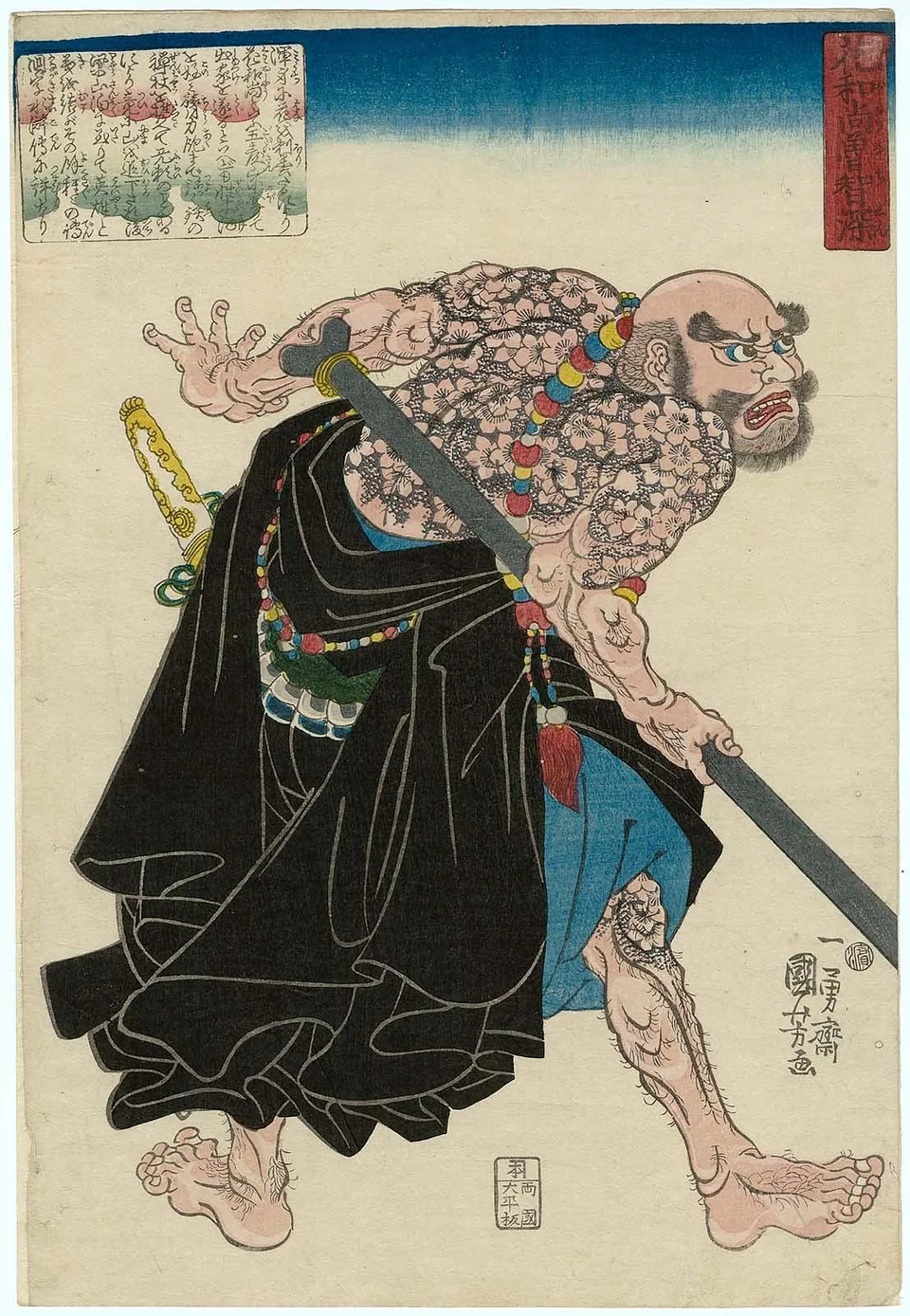
Utagawa Kuniyoshi's Kaoshō Rochishin, the Flower Monk, from his series One Hundred and Eight Heroes of the Popular Suikoden, needs the same care. The Chinese novel says only that Lu Zhishen bared the huaxiu, the "flower embroidery", on his back, without naming a flower [36]. The British Museum's record describes the tattoo on the shoulders in Kuniyoshi's print as cherry blossoms [37]. Ōnuki Naho's study, however, identifies the flower as crab apple or white plum, and notes that since hua, "flower", means tattoo in Chinese, "Flower Monk" means a tattooed monk [38]. The source text, the print and later research offer different identifications of the flower.
The cherry's role in Japanese tattooing and how seasons are matched
In Japanese tattooing, cherry blossoms usually complement the main subject. Nihon dentō irezumi explains keshōbori, decorative carving, as placing maple, cherry, chrysanthemum, peony and the like around the main design. It divides the roles so that keshōbori gives the season and gakubori, the framing background, gives natural phenomena such as waves, rocks, clouds, whorls, light and flame [17]. The same book defines the fū, the 'wind', of kachō fūgetsu as nature itself, taking in wind and cloud, rain, haze and mist, thunder, rivers and marshes, the sea and its waves and more, and says that Japanese traditional tattooing expresses these phenomena through the form called the gaku. For a dragon in flight, it adds, the gakubori carries cloud, wind, thunder, rain and sunlight to show the state of the sky [17]. Read through kachō fūgetsu, the cherry stands on the side of the 'flower' and the gaku on the side of the 'wind'. Ōnuki Naho defines keshōbori as cherry, maple, clouds, waves and so on arranged around the central motif to set it off, counting clouds and waves on the keshōbori side [38]. A working tattooist explains that depicting cherry petals as if seen through swirling wind adds depth to a tattoo [39].
Seasons have their customs. The same tattooist writes that when a piece is finished with a background, cherry, chrysanthemum, peony and maple should share a season as far as possible, and that it is customary to unify the season at least within the back, or within the shoulder. Among designs whose partners are fixed, he names the peony for the Chinese lion and the chrysanthemum, cherry or maple for the dragon [40]. He also notes cases where the story fixes the flower, giving "the cherry of the spirit of the Komachi cherry" as an example [40]. That is the spirit of a cherry that blooms in midwinter in Tsumoru koi yuki no seki no to, first staged in 1784 [41]. Where the story fixes the flower, it can be read as taking precedence over the rule of the season.
There is choice, too, in the form of the cherry you draw. Edo townspeople looked at mountain, higan and double-flowered cherries [8], and cherry crests come in forms such as the mountain cherry, the Hosokawa cherry and the double-flowered cherry [42]. Hanaikada, "flower raft", likening petals strung along the water's surface to a raft, appears in the Kanginshū of 1518 [43]; hanafubuki, the "blossom blizzard" of scattering petals, is attested in mid-Edo haikai [44]. Which cherry you tattoo, and how it falls, sets the season and the period of the whole composition.
Decide first which layer of the cherry you will tattoo
Taken together, the cherry carries at least five layers of meaning: the transience of the Kokinshū and the sange of the Buddhist rite; Saigyō, who wished to die beneath the blossoms; Norinaga's mountain cherry, a heart moved by beauty; the tattoos of the Edo stage, marks of love and proofs of identity; and the reading of falling without regret, running from warrior aesthetics to modern army songs. The meaning of a storm of petals depends on which of these traditions the design draws on. That choice can guide the falling petals, colours and accompanying subject.
The pairing of cherry and death has a long lineage too. In Yoshitani Haruna's description, quoted by Hirai Noriyuki, the scroll of the impure human realm in the Six Realms paintings of Shōju Raigō-ji sets full cherry blossoms beside a decaying corpse, the white petals falling on the body [30]. In Tanizaki Jun'ichirō's story "The Tattooer", the tattooer Seikichi shows a girl a scroll of a young woman leaning against the trunk of a cherry tree, gazing at the corpses of many men fallen at her feet [45]. The cherry was never only a beautiful flower; it has also mirrored death and enchantment.
Before settling the design, tell us which layer of the cherry you want to tattoo. Is it a storm of offering flowers, petals scattered around a subject like the recorded tattoo, or the mountain cherry itself? We work out a composition that follows the body, including how far the season should be matched and which subject it partners. If you want several layers on one body, assigning a story to each area brings them together without strain. These sources can help you choose what your cherry blossom tattoo will express.
FAQ
Does a cherry blossom tattoo mean a warrior's clean death?
That is only one layer of meaning. In the Nihon Kokugo Daijiten, the oldest example of hana to chiru meaning "to die cleanly" is the late-Meiji army song "Hohei no honryō". The aesthetic of a clean falling is also said to have roots in the rise of the warrior class, but in the Heian Kokinshū falling blossoms were a sigh at time that cannot be held back, and one reading links them to the Buddhist scattering of flowers in offering. Cherry blossoms have carried several meanings across these traditions.
Where does "the cherry among flowers, the warrior among men" come from?
The Nihon Kokugo Daijiten cites act ten of Kanadehon Chūshingura (1748), where the line is spoken in praise of a resolve that even warriors cannot match. It means that among flowers the cherry excels, and among men the warrior.
Did Tōyama no Kin-san really have a cherry-storm tattoo?
Contemporary records do not confirm it. Dictionaries treat it as popular tradition or a storyteller's embellishment, and a reference case from the Edo-Tokyo Museum library finds no reliable document. The scene of baring a shoulder to show the cherry storm was fixed by Jinde Tatsurō's novels and the television and films adapted from them.
Were there cherry blossom tattoos in the Edo period?
The stage gives firm examples. In Sakurahime azuma bunshō (1817) the princess copies Gonsuke's bell-and-cherry tattoo onto her arm, and in Aoto zōshi hana no nishiki-e (1862) Benten Kozō reveals himself by baring a cherry tattoo. Among records of real tattoos, a woman thief of the Meiji Restoration era known as Kaminari Oshin reportedly had four heroes with scattered cherry blossoms on her left arm.
Can cherry blossoms be tattooed with other flowers?
According to a working tattooist, the season is best kept consistent, and it is customary to unify it at least within the back, or within the shoulder. Some designs have fixed partners, such as chrysanthemum, cherry or maple for the dragon and peony for the Chinese lion. The same tattooist notes that a story can fix the flower, as with the midwinter spirit of the Komachi cherry in Seki no to.
References
- [1] Nitō Atsushi. Cherry blossoms in ancient Japan (Kurashi no shokubutsuen dayori No. 427). (National Museum of Japanese History, 2023). Link
- [2] Ōishi Yasuo. Folk cherries and Man'yō cherries (Kokugakuin zasshi 116:1). (Kokugakuin University, 2015). Link
- [3] Kotobank. Ume, plum (Nihon Kokugo Daijiten). (Shogakukan). Link
- [4] International Research Center for Japanese Studies. Kokin wakashū (waka database). (Nichibunken). Link
- [5] Kotobank. Hanami, flower viewing (Sekai Daihyakka Jiten). (Heibonsha). Link
- [6] Kita City Asukayama Museum. The cherry trees of Asukayama. (Kita City, Tokyo). Link
- [7] Flower Association of Japan. Somei-yoshino (cherry encyclopedia). (Flower Association of Japan). Link
- [8] National Diet Library. Book Kaleidoscope No. 9: Flower viewing. (National Diet Library). Link
- [9] Sada Kimiko. On Tsurayuki's poems of falling blossoms in the Kokinshū, spring 2: a possible link to sange (Chūko bungaku 73). (Chūko Bungakkai, 2004). doi:10.32152/chukobungaku.73.0_1. Link
- [10] Kotobank. Hana to chiru (Nihon Kokugo Daijiten). (Shogakukan). Link
- [11] Kotobank. Sange (Nihon Kokugo Daijiten, Digital Daijisen). (Shogakukan). Link
- [12] International Research Center for Japanese Studies. Sankashū (waka database). (Nichibunken). Link
- [13] International Research Center for Japanese Studies. Shokukokin wakashū (waka database). (Nichibunken). Link
- [14] Kotobank (Kubota Jun). Saigyō (Nihon Daihyakka Zensho). (Shogakukan). Link
- [15] Kotobank. Kenkyū era (Nihon Kokugo Daijiten). (Shogakukan). Link
- [16] Kotobank. Saigyō-zakura (Digital Daijisen, Sekai Daihyakka Jiten). (Shogakukan, Heibonsha). Link
- [17] TATTOO BURST editorial team (text by Kawasaki Miho). Nihon dentō irezumi, vol. 2 (Kachō fūgetsu; Yūgen, wabi, sabi), pp. 22, 52, 72. (Core Magazine, 2005)
- [18] Kotobank. Hana wa sakuragi hito wa bushi (Nihon Kokugo Daijiten, Kotowaza wo shiru jiten). (Shogakukan). Link
- [19] Tokyo National Research Institute for Cultural Properties. Self-portrait of Motoori Norinaga at sixty-one. (Tobunken). Link
- [20] Motoori Norinaga Memorial Museum. Major collection (including Norinaga's self-portrait at sixty-one). (Motoori Norinaga Memorial Museum). Link
- [21] Motoori Norinaga Memorial Museum. The Shikishima poem. (Motoori Norinaga Memorial Museum). Link
- [22] Komaki City Central Library (Collaborative Reference Database). On the meaning of Norinaga's Shikishima poem (quoting the Nihon Kokugo Daijiten entry yamato-gokoro). (National Diet Library). Link
- [23] Saitama Prefectural Kuki Library (Collaborative Reference Database). Origin of the names of the first special attack units (Collaborative Reference Database). (National Diet Library). Link
- [24] Emiko Ohnuki-Tierney. Kamikaze, Cherry Blossoms, and Nationalisms: The Militarization of Aesthetics in Japanese History (Japanese edition: Nejimagerareta sakura, Iwanami Shoten, 2003). (University of Chicago Press, 2002). Link
- [25] Kotobank. Sakurahime azuma bunshō (Digital Daijisen, Sekai Daihyakka Jiten and others). (Shogakukan, Heibonsha). Link
- [26] Japan Arts Council, Digital Library of Performing Arts. Invitation to Kabuki: Sakurahime azuma bunshō. (National Theatre of Japan). Link
- [27] Kotobank. Aoto zōshi hana no nishiki-e (Sekai Daihyakka Jiten, Nihon Daihyakka Zensho). (Heibonsha, Shogakukan). Link
- [28] Japan Arts Council, Digital Library of Performing Arts. Invitation to Kabuki: Aoto zōshi hana no nishiki-e, highlights. (National Theatre of Japan). Link
- [29] Japan Arts Council, Digital Library of Performing Arts. Invitation to Kabuki: Aoto zōshi hana no nishiki-e, overview. (National Theatre of Japan). Link
- [30] Hirai Noriyuki. The ornamental study of tattooing: changing Japanese views of the body and costume culture at the turn of the modern era (doctoral thesis). (Kokugakuin University, 2020). Link
- [31] Kotobank. Tōyama Kagemoto (Nihon Daihyakka Zensho) and Tōyama Kinshirō (Digital Daijisen). (Shogakukan). Link
- [32] Kotobank. Tōyama Kinshirō (Digital Daijisen, Seisenban Nihon Kokugo Daijiten). (Shogakukan). Link
- [33] Edo-Tokyo Museum Library. On the tattoo of Tōyama Kinshirō (Collaborative Reference Database). (National Diet Library, 2011). Link
- [34] Kotobank. Jinde Tatsurō (20th-century Japanese biographical dictionary). (Nichigai Associates). Link
- [35] Broadcast Library. Tōyama no Kin-san torimonochō: The Man with the Falling Cherry Storm. (Broadcast Programming Center of Japan, 1971). Link
- [36] Attributed to Shi Nai'an and Luo Guanzhong. Shuihu zhuan (120-chapter edition), chapter 4. (Wikisource (transcription)). Link
- [37] Utagawa Kuniyoshi. Kaōshō Rochishin (British Museum record 2008,3037.10036). (ukiyo-e.org (reproducing the British Museum record)). Link
- [38] Ōnuki Naho. An analysis of the horimono in Utagawa Kuniyoshi's One Hundred and Eight Heroes of the Popular Suikoden (Core Ethics 6). (Graduate School of Core Ethics and Frontier Sciences, Ritsumeikan University, 2010). Link
- [39] Ryugendo (hand-poke tattooist Ryugen). Traditional tattoo, background work 5. (Ryugendo, 2019). Link
- [40] Ryugendo (hand-poke tattooist Ryugen). How to choose a tattoo design you will not regret. (Ryugendo, 2020). Link
- [41] Kotobank. Tsumoru koi yuki no seki no to (Nihon Daihyakka Zensho and others). (Shogakukan). Link
- [42] Kotobank. Sakura, cherry (Seisenban Nihon Kokugo Daijiten). (Shogakukan). Link
- [43] Kotobank. Hanaikada (Seisenban Nihon Kokugo Daijiten). (Shogakukan). Link
- [44] Kotobank. Hanafubuki (Seisenban Nihon Kokugo Daijiten). (Shogakukan). Link
- [45] Tanizaki Jun'ichirō. Shisei (The Tattooer). (Aozora Bunko, 1910). Link
Japanese tattoo in Tokyo
Turn Japanese tattoo history into a custom design
Explore traditional motifs, modern Japanese compositions, and the consultation process with our English-friendly Ueno studio.
Related Articles
What the Snake Carries in Japanese Tattooing, from the God of Mount Miwa to the Serpent of Dōjōji
Before it was a monster, the snake was a god. In the Nihon Shoki the god of Mount Miwa appears as a small snake; the water spirit that brings rain is called the mizuchi; and the woman of Dōjōji becomes a serpent and burns the bell. Chronicles, Chinese texts, Noh and Edo serial fiction help explain these meanings in Japanese tattooing, including how the white snake became associated with wealth.
2026.09.11
Kanji Tattoos That Went Wrong, and How to Get Yours Right
A single misread stroke can turn "big" into "dog," and a quick app translation can leave you wearing the words for a charcoal grill. Many documented kanji tattoo mistakes come from avoidable checks being skipped. The cases and checklist below explain how to check that your tattoo says what you mean.
2026.06.27
Wabori vs Tebori: The Basics of Traditional Japanese Tattooing
Wabori and tebori sound alike, but they name different things: one is a style of imagery, the other a way of putting ink into skin. This guide explains gaku backgrounds, mikiri borders, the use of hand-poking today, and the origins of the word irezumi.
2026.08.24