What the Snake Carries in Japanese Tattooing, from the God of Mount Miwa to the Serpent of Dōjōji
2026.09.11
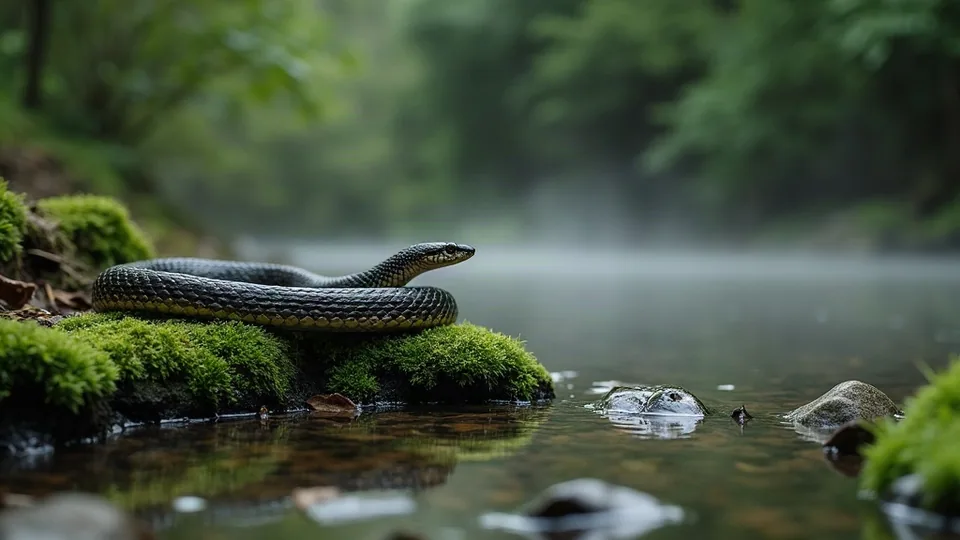
Before it was a monster, the snake was a god. In the Nihon Shoki the god of Mount Miwa appears as a small snake; the water spirit that brings rain is called the mizuchi; and the woman of Dōjōji becomes a serpent and burns the bell. Chronicles, Chinese texts, Noh and Edo serial fiction help explain these meanings in Japanese tattooing, including how the white snake became associated with wealth.
Before it was a monster, the snake was a god
Japan's oldest histories show the snake plainly as a god. In the Nihon Shoki, under the ninth month of the tenth year of Emperor Sujin, Yamato-totohi-momoso-hime, wife of Ōmononushi, the god of Mount Miwa, asks to see her husband's true form. At dawn she opens her comb box and finds a "beautiful little snake" (美麗小蛇), as long and as thick as a robe cord [1]. She cries out, and the god, ashamed, takes human form again and strides across the sky back to Mount Mimoro. In remorse she stabs herself with a chopstick and dies, and the chronicle says people called her grave Hashihaka, the Chopstick Tomb [1].
The Kojiki tells the same god's story but never names a snake. A thread tied to the robe of a lover who visits by night is followed the next morning: it has slipped out through the keyhole of the door and leads to the shrine on Mount Miwa [2, 3]. Kokugakuin University's database of divine names notes that this passage through the keyhole is read as a hint of a serpent body [2]. It adds that the Nihon Shoki names the "little snake" in the Sujin record and, in the Yūryaku record, shows the god as a great serpent whose thunderous roar and flashing eyes terrify the emperor [2].
In that record, the seventh month of the seventh year of Emperor Yūryaku, Chiisakobe no Muraji Sugaru captures the god of Mount Mimoro and shows it to the emperor. It is a great serpent; it rumbles like thunder and its eyes blaze red. The frightened emperor covers his eyes and has it released on the mountain. The chronicle then says the name Ikazuchi, "Thunder", was bestowed. Reference works identify Sugaru, not the serpent, as the one given the name Chiisakobe no Ikazuchi [4, 38]. At Ōmiwa Shrine today, worshippers leave eggs, the snake's favourite food, at the Mi-no-kamisugi, a sacred cedar said to house a white snake that is the incarnation of Ōmononushi [5]. This history of worship is one of the traditions behind snake designs in Japanese tattooing.
Mizuchi, the spirit of water, and a god both feared and enshrined
The bond between snake and water survives in a single word: mizuchi. The Digital Daijisen explains that the older form was mitsuchi, with mi meaning water, tsu meaning "of", and chi meaning spirit [6]. It is an imaginary creature, long and snake-like, and the Nihon Daihyakka Zensho notes many traditions of it bringing heavy rain; it has been thought of as a water god or a water god's messenger [6]. Read beside the Mount Mimoro story, in which the great serpent rumbles like thunder, the mizuchi traditions show how snakes, thunder and water could be imagined together.
The Nihon Shoki's record for the sixty-seventh year of Emperor Nintoku tells of a man who cut down a mizuchi. At a fork of the Kawashima River in central Kibi, a great mizuchi (大虬) spat poison and tormented the people. Agatamori, ancestor of the Kasa no Omi, threw three gourds into the pool and made his challenge: sink these and I will leave you; fail, and I will cut you down. The creature turned into a deer and tried, but the gourds would not sink, and Agatamori cut down the creature and all its kind in the depths. The river ran with blood, and the pool was named after Agatamori, the chronicle records [7].
Old records also keep the idea that the god who curses and the god who is worshipped can be one and the same. The Yato-no-kami of the Hitachi-no-kuni Fudoki, in its Namekata district section, are snake gods named for yato, the low wet ground in valleys. In the reign of Emperor Keitai they attacked in swarms the band of Yahazu no Uji no Matachi as they tried to clear the reed beds [8]. Matachi drove them back, set a boundary and enshrined them beyond it [8]. Such accounts show the snake as a being capable of bringing either fortune or harm.
The dragon is assembled from the snake
Chinese texts spell out how snake and dragon relate. Luo Yuan's Erya yi, from the Southern Song, quotes Wang Fu of the Later Han describing the popular way of drawing dragons as "horse's head, snake's tail", then gives the theory of the nine resemblances: horns like a deer, head like a camel, eyes like a demon, nape like a snake, belly like a shen (蜃), scales like a fish, claws like a hawk, palms like a tiger, ears like an ox [9]. People often say the body is a snake's, but in the original it is the nape that resembles a snake [9]. For the shen of the belly, one tattooist notes two readings, a giant clam (Toriyama Sekien) or a kind of mizuchi (Terajima Ryōan's Wakan sansai zue) [10]. At our studio we explain the dragon's belly as the mizuchi.
Some texts describe a snake becoming a dragon over time. The Shuyiji, attributed to Ren Fang of the Liang, records that a water serpent becomes a jiao (蛟) in five hundred years, the jiao becomes a dragon in a thousand, and the dragon becomes a horned dragon in five hundred and a ying dragon after a thousand more [11]. Japanese carries the same idea in a phrase. The Nihon Kokugo Daijiten traces umi ni sennen yama ni sennen, "a thousand years in the sea, a thousand in the mountains", to the popular belief that a snake that lives both becomes a dragon, citing a 1743 ukiyo-zōshi, Shogei sode nikki [12]. In these accounts, the snake is the dragon's earlier form.
Japan's image of the dragon itself rests on snake gods. Japan Search explains that it formed when native serpent deities such as the great serpents and Yamata-no-Orochi merged with foreign beliefs and legends, including the dragon of Chinese yin-yang lore and the Indian nāga [13]. Yamata-no-Orochi is written 八俣遠呂智 in the Kojiki and 八岐大蛇 in the Nihon Shoki [14]. A working tattooist notes that in tattoos and shrine carving such serpents are more often drawn as dragons than as snakes [15]. The book Nihon dentō irezumi likewise explains that the dragon, a guardian beast that came with Buddhism, overlapped with the snake of folk tales to form a combined dragon-serpent faith [16].
How a snake becomes a dragon
The ladder in the Shuyiji, attributed to Ren Fang of the Liang dynasty.
- 水虺water serpent500 years
- 蛟jiao / mizuchi1,000 years
- 龍dragon500 years
- 角龍horned dragon1,000 years
- 応龍ying dragon
The white snake's association with wealth, from the medieval period to Edo
The idea that a white snake brings money is not ancient belief as such. According to the Nihon Daihyakka Zensho, Benzaiten appears in the Sutra of Golden Light as a deity who grants wisdom, long life and wealth [17]. The Sekai Daihyakka Jiten explains that because her original form was said to be a snake god, customs arose of enshrining her near water, offering her favourite food, eggs, and hanging snake carvings [17]. The Nihon Kokugo Daijiten records that the true form of the Benzaiten of Enoshima is said to be a great serpent [17].
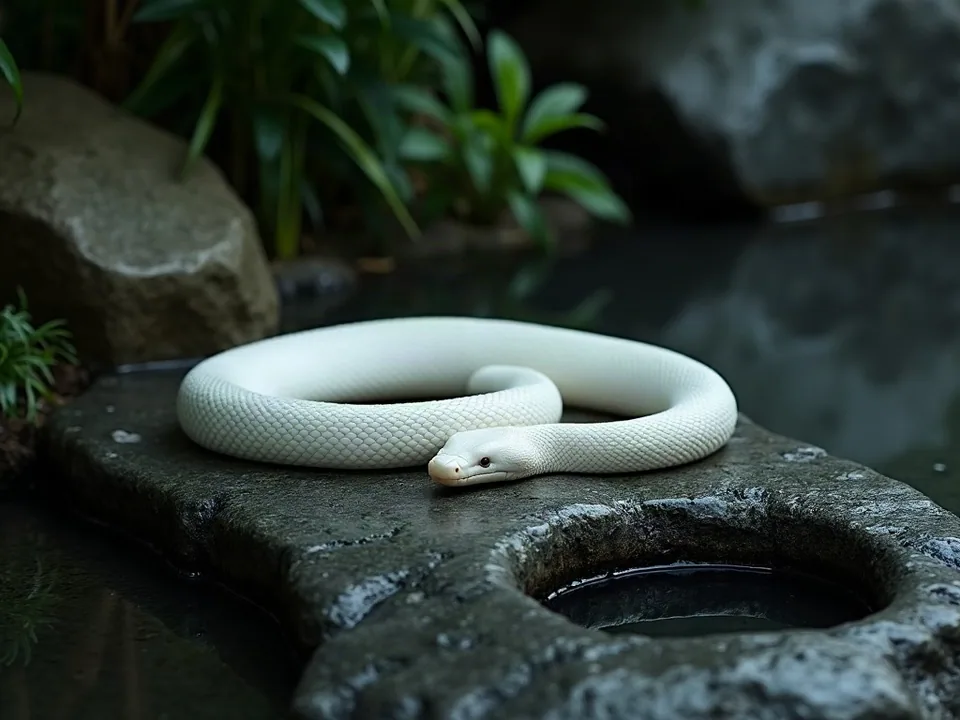
Overlaid on this is Ugajin. The dictionaries describe Ugajin as a god often identified with Benzaiten and, because a white snake sits inside Benzaiten's crown, as the white snake worshipped as a god, or white snakes in general [18]. The figure of Ugajin with a human head on a serpent's body, and the medieval esoteric world that taught Ugajin and Benzaiten as one, are examined at length in Yamamoto Hiroko's Ishin [19]. The white snake is also worshipped as Benzaiten's messenger. [Suitengu Shrine's account](https://www.suitengu.or.jp/hoshobenzaiten) describes Ugajin on her crown and messenger snakes at her feet. These are related traditions, rather than mutually exclusive descriptions.
The belief in money spreads among ordinary people in the Edo period. The Sekai Daihyakka Jiten notes that Benzaiten's feast day was fixed on days of the Earth Snake, and that in the Edo period her name was also written with the character for wealth, 弁財天, as she was widely worshipped as a god of saving [17]. The Nihon Kokugo Daijiten defines mimachi as a gathering held at the hour of the snake on Earth Snake days to worship Benzaiten, citing the haikai collection Batei nihyakku of 1683 [20]. At Zeniarai Benzaiten in Kamakura, the shrine's origin story tells that Ugafukujin appeared in a dream to Minamoto no Yoritomo, and that Hōjō Tokiyori washed coins on a snake day and prayed [21]. These medieval and Edo traditions inform the white snake's association with wealth.
The serpent beyond the hannya: the shinja of Dōjōji
Behind pairing the hannya and the snake in Japanese tattooing lies the story of Dōjōji. The Sekai Daihyakka Jiten notes that older versions appear in the Dainihonkoku Hokke genki, from the Chōkyū era (1040 to 1044), and in the Konjaku monogatari shū, where the woman has no name. The monk is first named Anchin of Kurama-dera in the Genkō shakusho, and the names Anchin and Kiyohime are surprisingly recent [22]. Dōjōji's own Dōjōji engi, an Important Cultural Property, is a picture scroll of the late Muromachi period, the sixteenth century. Across two scrolls, 11.25 m and 11.12 m long, it shows the woman turning gradually into a serpent as she pursues the monk [23].
The Noh play Dōjōji is attributed to Kanze Kojirō Nobumitsu. Its second-half lead wears a hannya or a shinja mask. Beneath the outer brocade the lead wears a white robe with a metallic-leaf scale pattern and a scaled sash, and in the second half sheds the brocade to reveal the scales [24]. The second-half lead of Kanawa wears the Hashihime or namanari mask [25]. The Nihon Daihyakka Zensho explains that the white hannya, which stresses dignity, is used for Aoi no Ue and the fiercer hannya for Kurozuka. It then says the ja, or snake, mask, which stresses the ferocity of the beast in desire, is used for Dōjōji [26]. Set namanari, hannya and the snake side by side, and they read as masks that change as a woman's obsession deepens. The hannya is not the end; the serpent lies beyond it.
The objects survive. The Tokyo National Museum holds an eighteenth-century Edo-period Noh mask called Ja, representing the vengeful spirit of a woman turned serpent by jealousy, with horns and fangs [27]. The shinja attributed to Shakuzuru in the Hōshō-kai collection, a Muromachi work, was designated an Important Cultural Property in 1963 [28]. Tsukioka Yoshitoshi also depicted Kiyohime turning into a serpent at the Hidaka River in his series New Forms of Thirty-six Ghosts [29]. Once you know the Noh costume is patterned with scales, triangular scale motifs placed around a hannya read as a pointer to the serpent of Dōjōji.
The hannya is not the last stage
Namanari, hannya and snake masks, set beside the plays that use them.
- 生成namanari
- Kanawa, second half
- Also associated with the Hashihime mask
- 般若hannya
- White hannya: Aoi no Ue
- Fierce hannya: Kurozuka
- 蛇・真蛇ja / shinja
- Dōjōji, second half
- Stresses the beast in desire
- Shinja attributed to Shakuzuru: Important Cultural Property (Hōshō-kai)
Edo serial fiction and the sorcerer of snakes
In Edo popular fiction, the illustrated serial Jiraiya gōketsu monogatari spread the snake's image. Forty-three instalments appeared between 1839 and 1868 before it was left unfinished, illustrated by Utagawa Kunisada, Utagawa Kuniyoshi and others [30]. The Sekai Daihyakka Jiten points to the snake-spirit bandit Orochimaru and to the device of a three-way standoff in magical combat. In 1852 Kawatake Shinshichi, later known as Mokuami, adapted it for kabuki, and Ichikawa Danjūrō VIII's Jiraiya was a sensation [30]. Waseda University Library makes an original Kansendō edition available online [31].
A tattooist's account describes Orochimaru as born with scales from the belly of a slain great serpent, named Emiwaka but called Jawaka behind his back, and becoming a bandit chief on Sado [32]. The three-way standoff of Jiraiya's toad, Orochimaru's snake and Tsunade's slug lets three creatures coil together in one composition. Here the snake is a character in a story, which gives the design a different meaning from a snake depicted on its own.
Warriors slaying monsters tied to dragon gods are also designs taken from stories. According to the Nihon Daihyakka Zensho, the tale in which Tawara Tōda, crossing the Seta bridge on Lake Biwa, kills a giant centipede at the request of the dragon god living beneath the bridge appears in the Taiheiki, book 15. It grew further in the Tawara Tōda monogatari and became the Noh play Mukade [33]. Stories like these were drawn as ukiyo-e, and the prints became sketches for tattoos. Tanigawa Atsushi calls Kuniyoshi's series One Hundred and Eight Heroes of the Popular Suikoden, first published in 1827, the high point of tattoo ukiyo-e. He also quotes Gunji Masakatsu's essay "Irezumi to yakusha-e" (1976): Japanese tattooing is ukiyo-e that left the paper for human skin [34].
How the snake is placed, and how to read its partners
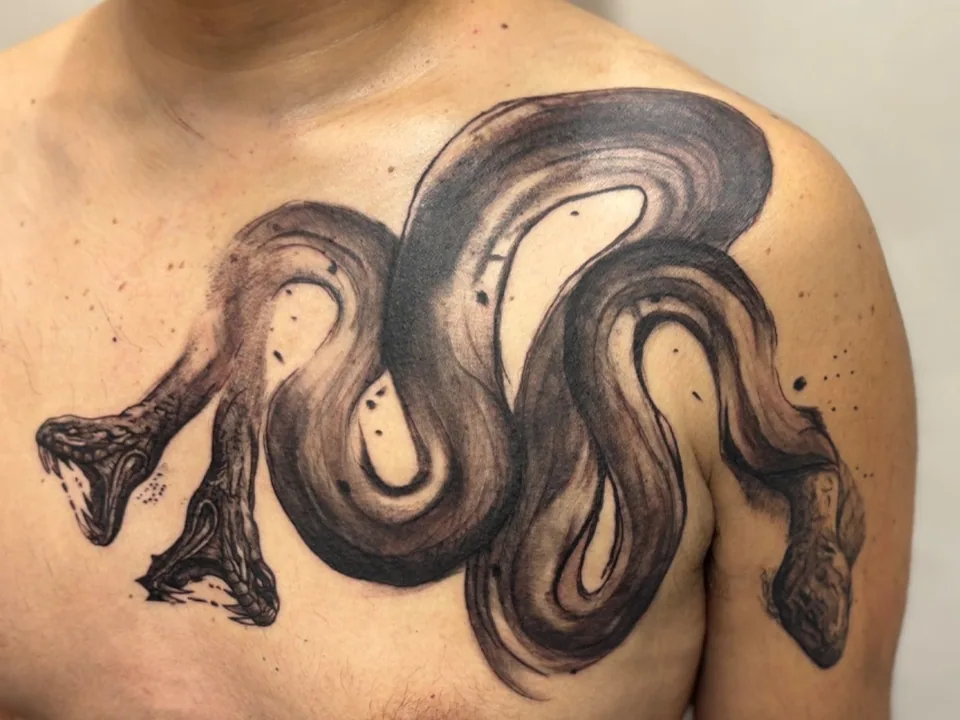
The snake is one of the designs that sit most naturally on the body's curves. Coiled around an arm or a leg, its body undulates with the muscles and seems to come alive with each movement. Run from chest to shoulder, it takes its weight from the thickness of the body and the gradation of ink, and the direction of the head sets where the eye travels. The piece in the opening photograph swings a thick body in brush-like washes of ink; on the chest side the body forks into two heads with open mouths, while the head on the shoulder keeps its mouth closed. The body carries no drawn scales and builds its volume from the gradation of black alone.
Its partners are chosen by which face of the snake you want to bring forward. A peony, king of flowers, answers the snake's menace with splendour; a skull brings out the contrast of death and rebirth. With a hannya it becomes the story of Dōjōji, and a white snake with waves or water leans toward Benzaiten and the water gods. When flowers are added, a working tattooist explains that cherry, chrysanthemum, peony and maple used in the background should share a season as far as possible, and that it is customary to keep one season at least within the back, or within the shoulder [35].
Luck is not the only reason for a snake. The same tattooist writes of people who, knowing themselves to be fickle, choose the snake for its tenacity, or who, always quarrelling, add Kannon to balance themselves [36]. It is the idea of making up in the design for what you lack. Because the snake carries both fortune and harm, what it is paired with and where it sits change its meaning clearly. In a design consultation, the qualities you want the tattoo to express can help guide these pairings.
Decide first which lineage of snake you will carry
Taken together, the snake in Japanese tattooing has at least four lineages: the snake as a divine presence associated in the sources with Miwa, water and thunder; the snake as the dragon's earlier form; the white snake of wealth, layered with Ugajin and Benzaiten; and the snake of Dōjōji, obsession given form. Raising the water spirit with a thick body in black ink, carrying fortune with a white snake, or telling a story with a hannya and scale motifs, the same snake becomes an entirely different design. Choosing the tradition you want to draw on can guide the colour and composition.
For readers who want to go deeper into snake worship itself, there is Yoshino Hiroko's Hebi: Nihon no hebi shinkō. Yoshino argues that ancient Japan had a vigorous snake cult, that many snake forms appear on Jōmon pottery, and that intense awe and revulsion toward the snake produced snake symbols such as the shimenawa rope and the kagami mochi [37]. Reading the shimenawa as a snake is best taken as Yoshino's thesis, but it opens a way into the sense of the snake as a god close at hand.
Before settling the design, tell us which lineage you want to carry. Will it be the little snake of Miwa, the serpent body of Dōjōji, or a dragon holding a mizuchi in its belly? We discuss the story and accompanying motifs, then work out a composition that fits the curves of your body. Where several lineages appeal, arranging which story sits where on the body lets them come together in one composition. The sources can help you choose which meaning your snake tattoo will express.
FAQ
Is a snake tattoo unlucky in Japan?
Not in itself. In the Nihon Shoki, Ōmononushi, the god of Mount Miwa, appears as a small snake, and another episode presents the god of Mount Mimoro as a great serpent that rumbles like thunder and flashes its eyes. At Ōmiwa Shrine, eggs are still offered at a sacred cedar said to house a white snake that is Ōmononushi's incarnation. The snake has been feared and enshrined at once, and its meaning changes with what it is paired with.
Is the white snake Benzaiten's messenger?
Yes, the white snake is worshipped as Benzaiten’s messenger, as Suitengu Shrine explains. There is also a related tradition of worshipping a snake deity as Ugajin, who appears on Benzaiten’s crown. The deity and messenger traditions coexist; one does not rule out the other.
How are the snake and the dragon related?
In the nine resemblances listed in Luo Yuan's Erya yi, the dragon's nape resembles a snake. The Shuyiji, attributed to Ren Fang, records that a water serpent becomes a jiao in five hundred years and the jiao a dragon in a thousand, and Japanese has the phrase "a thousand years in the sea, a thousand in the mountains" for a snake that becomes a dragon. The snake has also been told as the dragon's earlier form.
Why are the hannya and the snake tattooed together?
The story of Dōjōji lies beneath it. In the Noh play Dōjōji the second-half lead wears a hannya or shinja mask, and sheds the outer brocade to reveal a white robe patterned with scales. Set namanari, hannya and the snake side by side and they read as the deepening of obsession, with the serpent beyond the hannya. Triangular scale motifs placed around a hannya can be read as a pointer to that serpent.
Which flowers go with a snake?
It depends on which aspect of the snake you want to emphasise. A peony answers the snake's menace with splendour, and a skull brings out death and rebirth. When flowers are added, a working tattooist recommends keeping the season consistent, and says it is customary to unify it at least within the back, or within the shoulder. The meaning you want to express can guide the choice of flower.
References
- [1] Compiled under Prince Toneri. Nihon Shoki, book 5 (Emperor Sujin, year 10, ninth month). (Wikisource (transcription), 720). Link
- [2] Kokugakuin University, Classical Culture Project. Ōmononushi-no-kami (database of divine names). (Kokugakuin University). Link
- [3] Ōmiwa Shrine. Tales of the god of Mount Miwa. (Ōmiwa Shrine). Link
- [4] Compiled under Prince Toneri. Nihon Shoki, book 14 (Emperor Yūryaku, year 7, seventh month). (Wikisource (transcription), 720). Link
- [5] Ōmiwa Shrine. Mi-no-kamisugi (sacred cedar). (Ōmiwa Shrine). Link
- [6] Kotobank. Mizuchi (Digital Daijisen, Nihon Daihyakka Zensho, Nihon Kokugo Daijiten). (Shogakukan and others). Link
- [7] Compiled under Prince Toneri. Nihon Shoki, book 11 (Emperor Nintoku, year 67). (Wikisource (transcription), 720). Link
- [8] Kotobank. Yato-no-kami (Sekai Daihyakka Jiten, Nihon Jinmei Daijiten+Plus). (Heibonsha, Kodansha). Link
- [9] Luo Yuan. Erya yi, book 28 (Siku quanshu edition). (Wikisource (transcription)). Link
- [10] Ryugendo (hand-poke tattooist Ryugen). Dragon (tattoo design notes). (Ryugendo). Link
- [11] Attributed to Ren Fang. Shuyiji, first volume (Siku quanshu edition). (Wikisource (transcription)). Link
- [12] Kotobank. Umi ni sennen yama ni sennen (Nihon Kokugo Daijiten). (Shogakukan). Link
- [13] Japan Search. Gallery: Dragons. (National Diet Library). Link
- [14] Kokugakuin University, Classical Culture Project. Yamata-no-Orochi (database of divine names). (Kokugakuin University). Link
- [15] Ryugendo (hand-poke tattooist Ryugen). Susanoo (tattoo design notes). (Ryugendo). Link
- [16] TATTOO BURST editorial team (text by Kawasaki Miho). Nihon dentō irezumi (Kachō fūgetsu 2: Birds and creatures). (Core Magazine, 2005)
- [17] Kotobank. Benzaiten (Sekai Daihyakka Jiten, Nihon Daihyakka Zensho, Nihon Kokugo Daijiten). (Heibonsha, Shogakukan). Link
- [18] Kotobank. Ugajin (Digital Daijisen, Nihon Kokugo Daijiten). (Shogakukan). Link
- [19] Yamamoto Hiroko. Ishin: Chūsei Nihon no hikyōteki sekai II, Uga Benzaiten and Gozu Tennō (revised edition). (Ebisu Kōshō Shuppan (first published by Heibonsha, 1998), 2024). Link
- [20] Kotobank. Mimachi (Nihon Kokugo Daijiten). (Shogakukan). Link
- [21] Kamakura City Tourism Association. Zeniarai Benzaiten Ugafuku Shrine. (Kamakura City Tourism Association). Link
- [22] Kotobank. Anchin and Kiyohime (Sekai Daihyakka Jiten). (Heibonsha). Link
- [23] Wakayama Prefectural Museum. Dōjōji engi: highlights. (Wakayama Prefectural Museum). Link
- [24] the-noh.com. Dōjōji: play data. (the-noh.com). Link
- [25] the-noh.com. Kanawa: play data. (the-noh.com). Link
- [26] Kotobank. Hannya, Noh mask (Nihon Daihyakka Zensho). (Shogakukan). Link
- [27] Tokyo National Museum (Cultural Heritage Online). Noh mask: Ja (snake). (Agency for Cultural Affairs). Link
- [28] Hōshō-kai (Cultural Heritage Online). Noh mask: Shinja, attributed to Shakuzuru. (Agency for Cultural Affairs). Link
- [29] Tsukioka Yoshitoshi (NDL Image Bank). New Forms of Thirty-six Ghosts. (National Diet Library). Link
- [30] Kotobank. Jiraiya gōketsu monogatari (Nihon Daihyakka Zensho, Sekai Daihyakka Jiten, Nihon Kokugo Daijiten). (Shogakukan, Heibonsha). Link
- [31] Waseda University Library, Japanese and Chinese Classics. Jiraiya gōketsu monogatari (Kansendō edition). (Waseda University Library). Link
- [32] Ryugendo (hand-poke tattooist Ryugen). Orochimaru (tattoo design notes). (Ryugendo). Link
- [33] Kotobank. The legend of Tawara Tōda (Nihon Daihyakka Zensho). (Shogakukan). Link
- [34] Tanigawa Atsushi. Preface to Nihon no zuzō: Irezumi (The Iconography of Japanese Tattoo). (PIE International, 2023). Link
- [35] Ryugendo (hand-poke tattooist Ryugen). How to choose a tattoo design you will not regret. (Ryugendo, 2020). Link
- [36] Ryugendo (hand-poke tattooist Ryugen). The meanings of tattoo designs. (Ryugendo). Link
- [37] Yoshino Hiroko. Hebi: Nihon no hebi shinkō (The Snake: Snake Worship in Japan). (Kodansha Gakujutsu Bunko (first published by Hosei University Press, 1979), 1999). Link
- [38] Kotobank editors. Chiisakobe no Sugaru (Revised Sekai Daihyakka Jiten). (Heibonsha). Link
Japanese tattoo in Tokyo
Turn Japanese tattoo history into a custom design
Explore traditional motifs, modern Japanese compositions, and the consultation process with our English-friendly Ueno studio.
Related Articles
What the Cherry Blossom Tattoo Has Meant, from the Kokinshū to Benten Kozō
A storm of cherry blossoms in a tattoo is said to stand for a warrior's clean death. Yet the oldest example in the dictionaries of "scattering like a flower" meaning "to die cleanly" is a late-Meiji army song. The sources trace these meanings through the Kokinshū, where blossoms evoke transience and offerings; Saigyō's wish; Edo-stage tattoos, including Benten Kozō's; and modern appropriations.
2026.09.11
Kanji Tattoos That Went Wrong, and How to Get Yours Right
A single misread stroke can turn "big" into "dog," and a quick app translation can leave you wearing the words for a charcoal grill. Many documented kanji tattoo mistakes come from avoidable checks being skipped. The cases and checklist below explain how to check that your tattoo says what you mean.
2026.06.27
Wabori vs Tebori: The Basics of Traditional Japanese Tattooing
Wabori and tebori sound alike, but they name different things: one is a style of imagery, the other a way of putting ink into skin. This guide explains gaku backgrounds, mikiri borders, the use of hand-poking today, and the origins of the word irezumi.
2026.08.24