What Does the Kirin Tattoo Mean? Its Forms and Variations in Wabori
Published · Updated
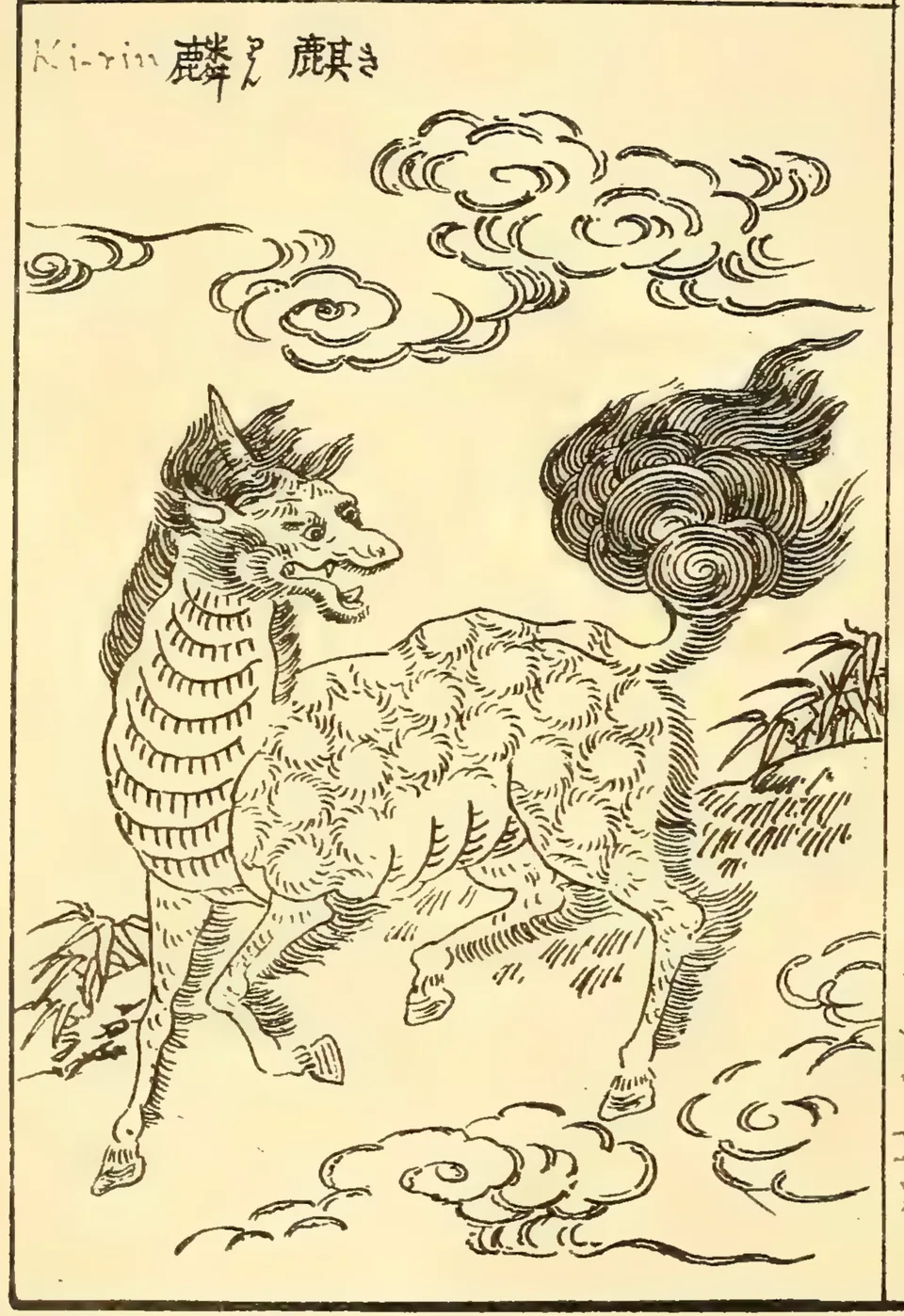
The kirin has long been described in Chinese classical texts as a benevolent spirit beast, embodying 'ren,' or humaneness. Japanese painting and craft have depicted it in many different forms. Drawing on classical texts and museum sources, this article introduces the kirin's character, the differences in its appearance, and what to look for in wabori (traditional Japanese tattooing) reference sketches.
The Kirin as 'Benevolent Beast' in Chinese Classical Texts
The kirin has long been described in ancient Chinese texts as a beast possessing 'ren,' or humaneness. Ren refers to a quality of compassion and benevolence. The Gongyang Commentary on the Spring and Autumn Annals (Chunqiu Gongyang Zhuan), in its entry for the fourteenth year of Duke Ai, records: '麟者,仁獸也' ('the qilin is a benevolent beast') [1]. He Xiu's commentary explains that it is called benevolent because, although it carries horns that could serve as weapons, it does not harm other creatures [1]. Despite possessing great strength, it does not use that strength to fight, and it was in this restraint that people saw virtue.
The Gongyang Commentary also touches on when the kirin appears. It states '有王者則至' ('when there is a true king, it comes') and '無王者則不至' ('when there is no true king, it does not come') [1]. According to He Xiu's commentary, this means it appears when a sage emperor or wise ruler governs the realm and the world is at peace [1]. The kirin described here is less a creature that brings good fortune on its own, and more an auspicious sign that appears in a well-governed age [1]. Such a sign is called a 'zuisho,' or propitious omen.
The Early Kirin: A One-Horned Beast Resembling a Deer
A clue to the kirin's early appearance can be found in the ancient dictionary Erya. It contains the passage '麠,大麃,牛尾,一角' [2]. The accompanying commentary explains that a large 麃 (biao) with an ox's tail and a single horn is called 麠 (jing), adding '麃,獐也' ('biao refers to the zhang,' a deer-like animal) and '即所謂麟也' ('this is what is called the lin') [2]. This tells us that the early kirin was conceived of as a one-horned beast close in form to a deer [2].
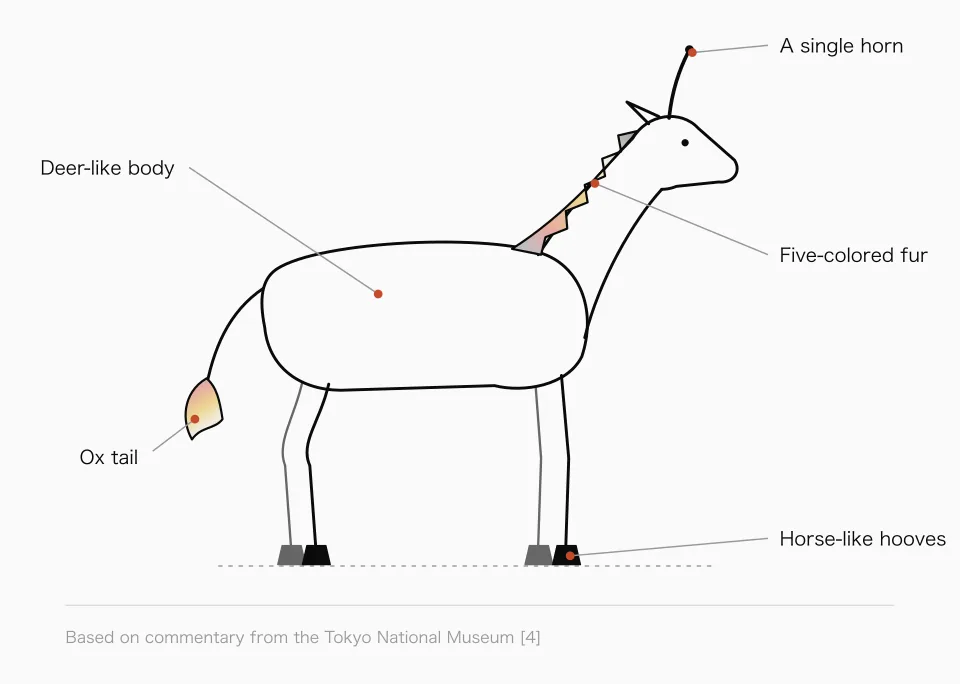
The Tokyo National Museum also describes the kirin as an imaginary animal with a body resembling a deer, a tail like an ox's, hooves like a horse's, a single horn, and fur of five colors [4]. It combines features drawn from several different animals. It's easier to remember if you take it part by part: the body is a deer, the tail an ox, the feet a horse. When working out a design for wabori, it helps to start from these basic features, since they make it easier to judge whether a reference sketch is on the mark.
The Kirin in Japan: A Motif in Craft and Painting
According to the Toguri Museum of Art, the kirin appears to have reached Japan by around the 8th century [5]. The Tokyo National Museum notes that the kirin is also depicted among the treasures of the Shōsōin [4]. It further observes that in Japan, the kirin more often appears as a decorative motif on craft objects than as the central subject of a painting [4]. In other words, it entered everyday life as a pattern that lent an auspicious air to vessels and tools.
Works survive from different periods. The Tokyo National Museum notes that the kirin appears in the late Heian-period Chōjū-jinbutsu-giga ('Scrolls of Frolicking Animals and People') [4]. Among the works it cites as examples are a 17th-century painting of a kirin by Kano Tsunenobu and a 19th-century netsuke carved in the kirin's likeness [4]. A netsuke is a small carved toggle used to fasten an item to the sash of a kimono. From picture scrolls to hanging scrolls to carvings small enough to rest in the palm of your hand, the kirin has been rendered at every scale and in every material.
Japan Search introduces the dragon, the phoenix, the kirin, the Chinese lion (karashishi), and the kalavinka (迦陵頻伽) as legendary creatures that have been passed down in Japan [6]. These have long been incorporated into the designs of Japanese art, as objects of both reverence and awe [6]. And, it notes, they have been painted and crafted to carry a variety of meanings and wishes [6].
One Horn or Two: The Kirin's Form in Japan Was Never Fixed
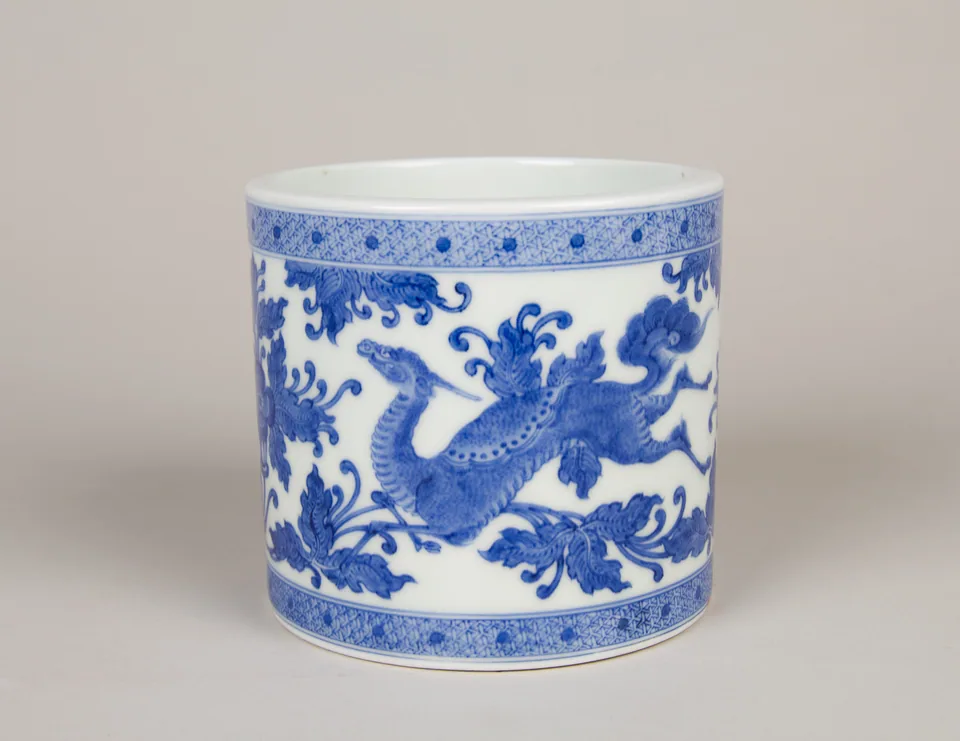
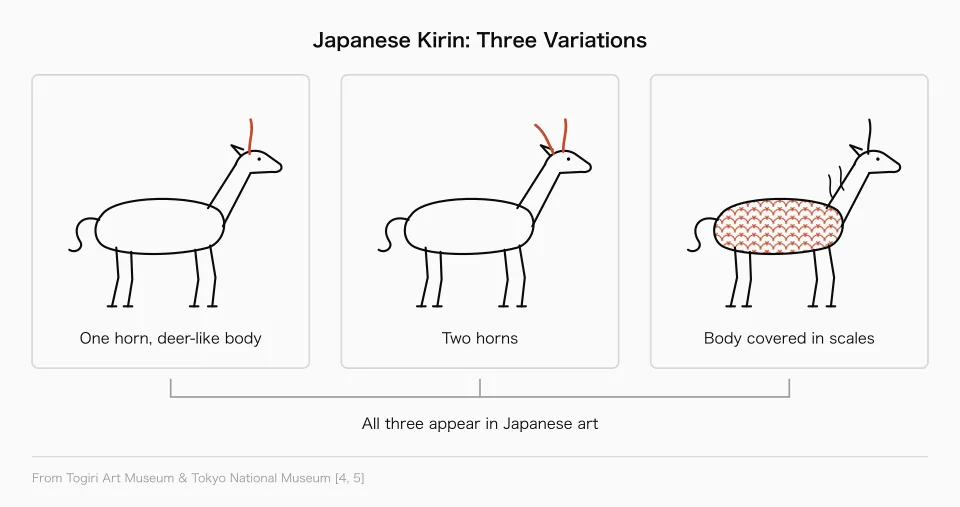
According to the Toguri Museum of Art, Japanese depictions of the kirin changed over time. In some examples, the single horn became two, or the body came to be covered in scales [5]. The museum classifies the kirin designs found on Old Imari ware into three types [5]. Even within the single field of ceramics, there was considerable range in how the kirin was drawn.
That said, the kirin's appearance did not change all at once after arriving in Japan. The Tokyo National Museum presents the kirin with a single horn [4]. And the kirin appears, in that same form, across scrolls, hanging scrolls, netsuke, and many other kinds of work [4]. The origins of the kirin and the evolution of its imagery are themselves a subject of ongoing research [3].
When tattooing a kirin in wabori, the number of horns and the presence or absence of scales are best understood not as 'correct' or 'incorrect,' but simply as variations in how it has been expressed. Both the simple, classical one-horned form and the more imposing scaled form have precedent in Japanese art. Which one to choose can be decided based on the overall composition and personal taste.
A Title That Says 'Kirin' Doesn't Guarantee It's a Kirin
When searching old paintings for reference sketches, there's a point worth keeping in mind. Just because a work's title mentions 'kirin' doesn't mean the creature depicted actually is one. The Toguri Museum of Art notes that in Tawaraya Sōtatsu's sliding-door painting 'Kirin Amid Waves,' the animal depicted is thought to be a suisai, or water rhinoceros, rather than a kirin [5]. Choosing a design based on the title alone can end up tattooing a different beast than intended.
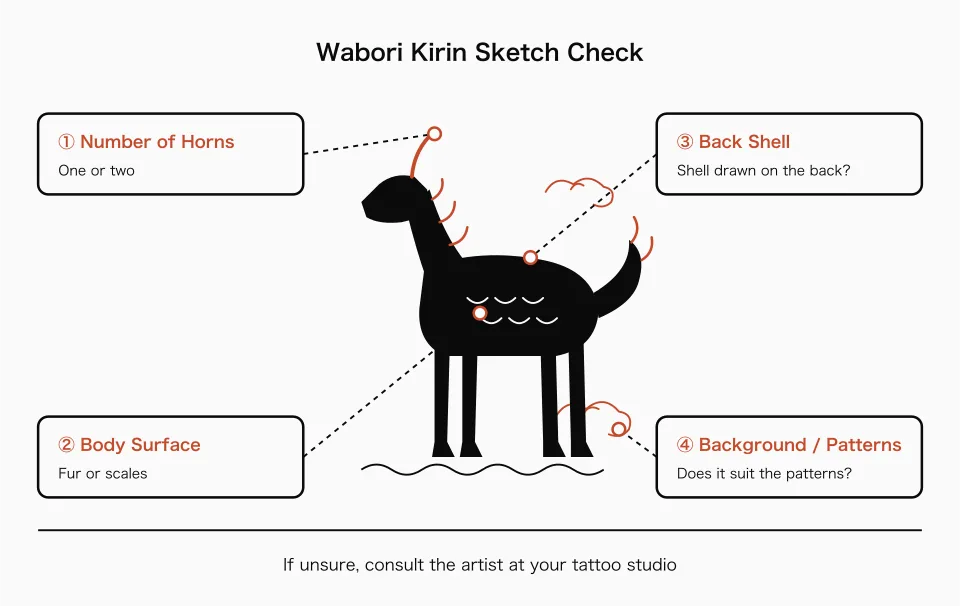
So what should you look for to tell the difference? Regarding Old Imari ceramics, the Toguri Museum of Art notes that being depicted alongside auspicious clouds, phoenixes, or sacred jewels is one clue used to identify a figure as a kirin [5]. In other words, the combination of motifs surrounding the creature helps reveal its true identity. For wabori reference sketches too, it's worth checking the number of horns, the texture of the body's surface, whether there's a shell on the back, and the relationship to the background, in order to confirm the imagery.
Meanings You Can Carry in a Kirin Wabori
From the character described in the classical texts, several meanings can be layered onto the kirin. One is 'ren,' the humaneness of a creature that holds great power yet does not harm others [1]. Another is 'peace' or 'good fortune,' the auspicious sign that appears in a well-governed age [1]. It's a motif that lends itself easily to wishes such as wanting to be someone who treats others with compassion, or hoping for calm, peaceful days to continue. Which meaning you carry is entirely up to you, and there's no need to settle on just one.
Japan's spirit beasts have been painted and crafted to carry a variety of meanings and wishes [6]. A kirin in wabori, too, can be a design onto which you project your own hopes.
What to Discuss With Your Tattooer Before Settling on a Sketch
Once you've decided to get a kirin, start by thinking about what form you want it to take. Whether it's closer to the classical one-horned form, or a two-horned, scale-covered version, will considerably change the impression it gives. Explanations and works published by museums such as the Tokyo National Museum and the Toguri Museum of Art are useful references for settling on an image [4, 5]. If you find a work that speaks to you, bring it to the studio and look it over together with your tattooer. It will speed things along.
Once you've found a reference image, it's also worth confirming whether the creature depicted is really a kirin. The number of horns, the surface of the body, whether there's a shell on the back, and what's drawn around it are all useful clues [5]. From there, tell your tattooer what you want the kirin to mean to you, and what you'd like to include in the background. Rather than being too bound by fixed rules of meaning, working together to think through how your wishes can come through in the design is the surest path to a piece you'll be happy with.
FAQ
What does a kirin tattoo mean?
In Chinese classical texts, the kirin is described as a 'benevolent beast' that bears horns yet does not harm other creatures, and as an auspicious sign that appears when the realm is at peace. From this character, meanings such as compassion, peace, and good fortune can be layered onto it. Which meaning you choose to carry is up to you.
Is the kirin's horn supposed to be one or two?
Older texts and the Tokyo National Museum's explanations present the kirin with a single horn. On the other hand, Japanese depictions of the kirin have, over time, included versions with two horns or a body covered in scales. Since multiple forms have been drawn in Japan as well, both have precedent.
Does adding clouds or waves around the kirin change its meaning?
There's no universal rule in wabori that fixes a meaning to each background motif. The background has a major effect on the overall mood and composition of the design, so it's best to share what you want the piece to express and work it out together with your tattooer at the studio.
Is it safe to use a painting titled 'Kirin' as a reference sketch?
Just because a work's title mentions 'kirin' doesn't guarantee that the creature depicted is actually a kirin. Tawaraya Sōtatsu's 'Kirin Amid Waves' sliding-door painting is thought to actually depict a suisai, or water rhinoceros. When using a work as reference, it's reassuring to check the number of horns, the texture of the body, and whether there's a shell on the back.
References
- [1] 『春秋公羊伝』、何休注、徐彦疏. 春秋公羊傳註疏 卷28(哀公十四年). (維基文庫, 成立年不詳(本文・注疏の伝承テキスト)). Link
- [2] 『爾雅』、郭璞注、邢昺疏. 爾雅注疏 卷十. (中國哲學書電子化計劃(Chinese Text Project), 成立年不詳(本文・注疏の伝承テキスト)). Link
- [3] 北進一. 麒麟・その聖なる獣:起源と図像の変遷をめぐって. (桐朋学園芸術短期大学紀要, 2009). doi:10.69292/0002000740. Link
- [4] 東京国立博物館. 幻の動物 麒麟. (東京国立博物館, 2012). Link
- [5] 小西. 古伊万里幻獣大全展より:色絵 獅子文 鉢. (戸栗美術館, 2022). Link
- [6] ジャパンサーチ. 霊獣・想像上の動物. (ジャパンサーチ, 公開年不詳). Link
Japanese tattoo in Tokyo
Turn Japanese tattoo history into a custom design
Explore traditional motifs, modern Japanese compositions, and the consultation process with our English-friendly Ueno studio.
Related Articles
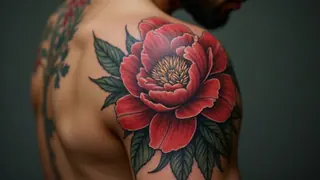
The Meaning of Peony Tattoos and Why It's Called the King of Flowers
In wabori, the Japanese tattoo tradition, peonies are as popular a flower motif as cherry blossoms. Why has the peony come to be called the "king of a hundred flowers" and the "flower of wealth and rank"? Tracing Tang-dynasty poetry, Northern Song essays, and the flower's history as a medicinal import to Japan, this guide lays out, like entries in a reference book, the meanings people have layered onto a single peony.
2026.10.12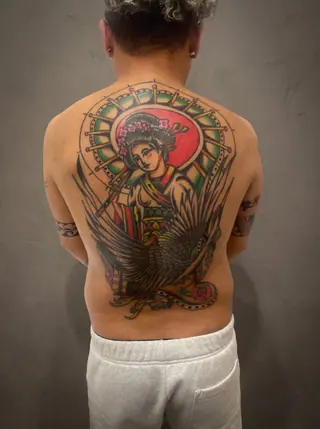
Shisei, Irezumi, Horimono, Wabori: What Do These Tattoo Words Really Mean?
Shisei, irezumi, horimono, and wabori can all describe putting ink into the skin, but each word was born in a different era and used in different settings. We've gone through how dictionaries, official documents, and research use each term, one by one. Knowing the impression each word carries will help you choose the right one for the moment.
2026.11.16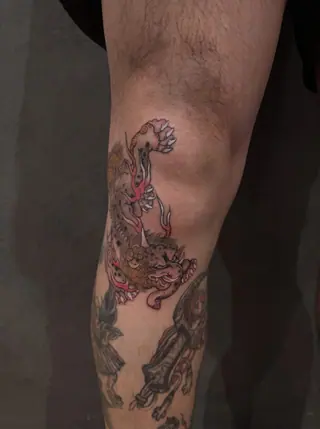
What Does a Karajishi Tattoo Mean? Its Difference from Komainu and Why Wabori Artists Choose It
Karajishi is an imagined beast born from the lion. In Japan it has long been loved as a guardian of temples and shrines, and as a motif for armor and fusuma (sliding door) paintings [2, 4]. Drawing on museum and dictionary sources, we look at where it came from, why it carries the character for "kara" (meaning foreign), and how it came to be tattooed.
2026.11.16