The Meaning of Peony Tattoos and Why It's Called the King of Flowers
Published · Updated
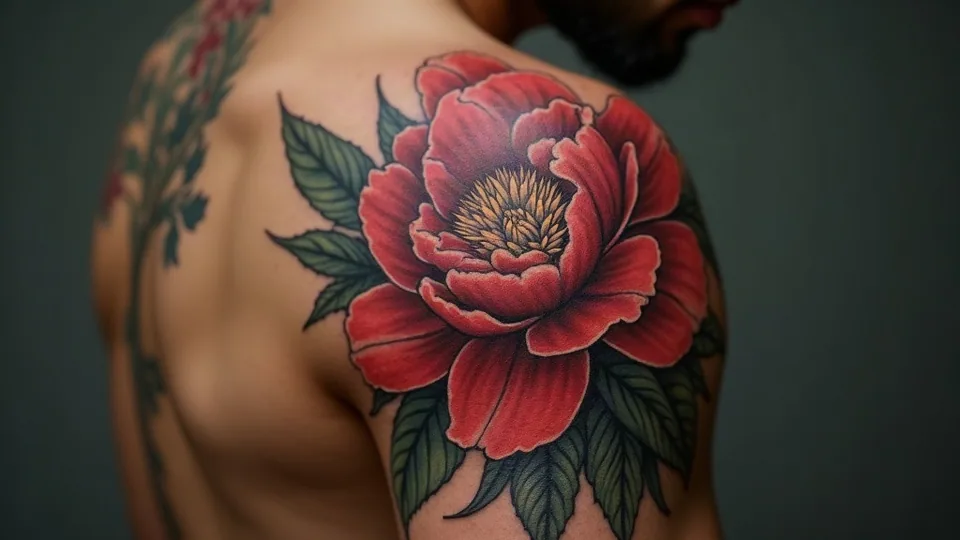
In wabori, the Japanese tattoo tradition, peonies are as popular a flower motif as cherry blossoms. Why has the peony come to be called the "king of a hundred flowers" and the "flower of wealth and rank"? Tracing Tang-dynasty poetry, Northern Song essays, and the flower's history as a medicinal import to Japan, this guide lays out, like entries in a reference book, the meanings people have layered onto a single peony.
The Tang Poem That Called It "King of a Hundred Flowers"
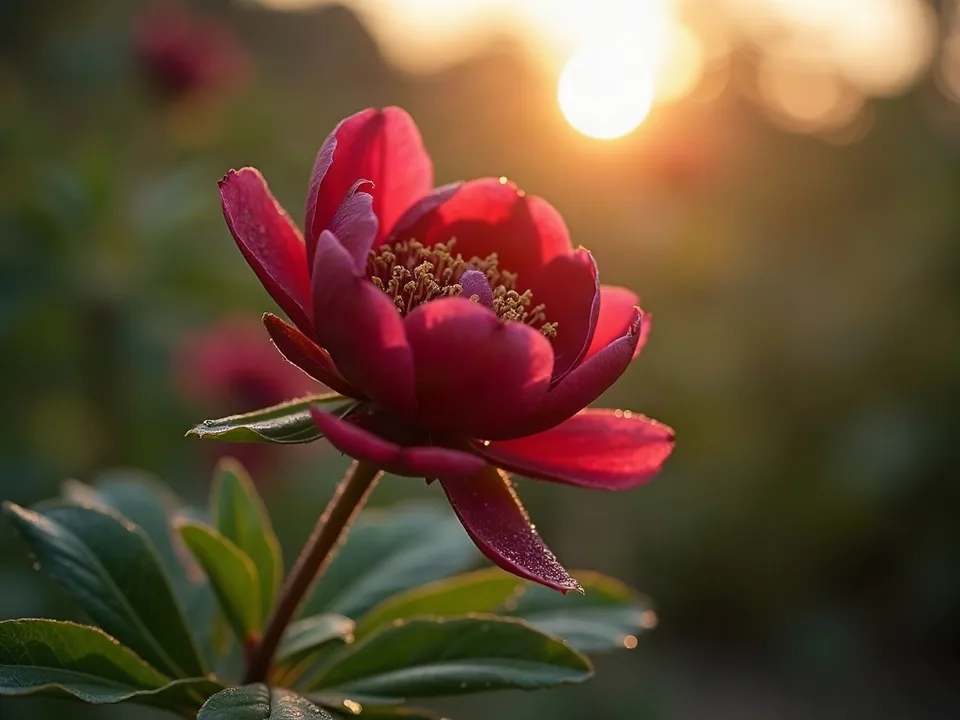
The peony is called the "king of a hundred flowers." One of the oldest known uses of this name appears in a seven-character quatrain titled "Peony" by the Tang-dynasty poet Pi Rixiu [2]. The poem begins, "Only after the last lingering red blossoms of spring have fallen does the peony begin to release its fragrance; its beautiful name is called king of a hundred flowers" [2]. In other words, once all the fading red flowers of spring have scattered, the peony finally sends out its scent, and so it came to be called by the beautiful name "king of a hundred flowers." The next two lines read, "Its splendor is unrivaled beneath heaven; alone in the human world, its fragrance ranks first," praising a beauty with no equal under heaven and a scent unmatched among all flowers [2].
What makes this poem notable is how the peony is portrayed as a "king who blooms late." It stands out precisely because it flowers after all the other blossoms have already fallen. It's also worth noting that the original text uses the term baika-ō (百花王), not the more familiar baika no ō (百花の王) often used in modern Japanese. The two phrases mean the same thing, "king of a hundred flowers," but when quoting the classical line directly, baika-ō is the historically accurate form [2].
Twenty Days That Sent the Whole Capital Into a Frenzy
Other poems hint at just how popular peonies were at the time. The Tang poet Bai Juyi describes the capital's atmosphere in his poem "Peony Blossoms." The line "This led princes and high officials to go flower-viewing day after day, their grand carriages lined up one after another" [3] captures nobles and officials setting out daily to admire the peonies, their carriage canopies stretching across the city. The poem continues, "For the twenty days the flowers bloom and fall, the whole city goes mad" [3], describing how, during the twenty days the peonies were in bloom, everyone in the capital seemed to lose their heads over them.
For a modern comparison, think of how Japanese cities fill with cherry-blossom crowds every spring. From princes and high officials down to ordinary city dwellers, the poem suggests, everyone was swept up in peony fever [3]. This memory carried into later eras. In one surviving version of his writings, the Northern Song scholar Zhou Dunyi recalls, "Since the Li Tang [the Tang dynasty], people of the world have greatly loved the peony" [1], looking back on this passion that began in the Tang period. Records like these from the Tang dynasty give us a sense of just how glamorous the peony's image once was.
Zhou Dunyi and the "Flower of Wealth and Rank"
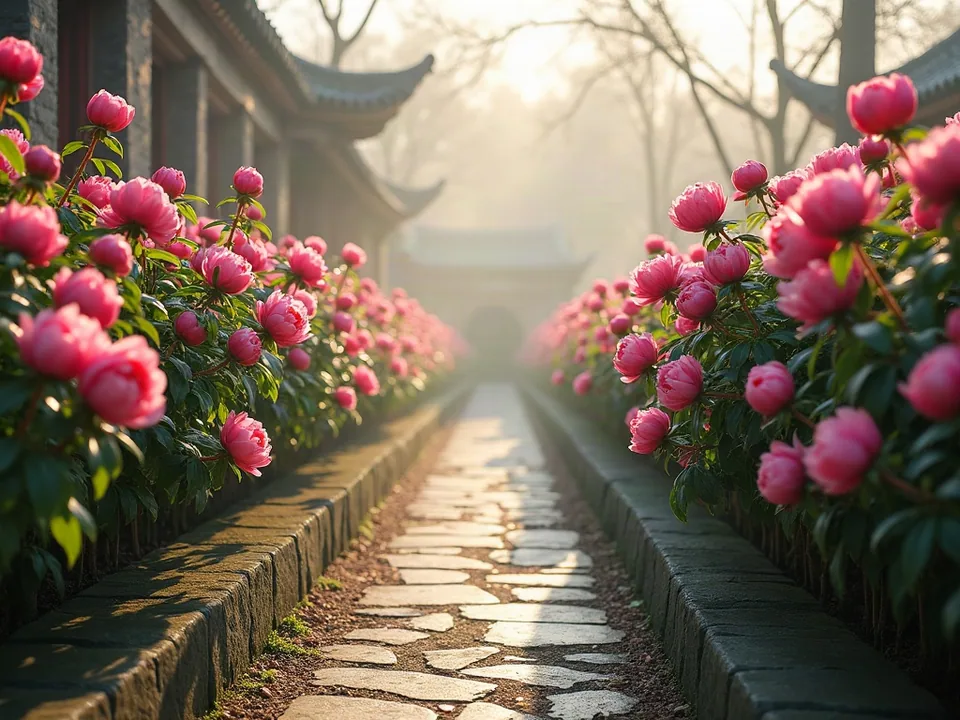
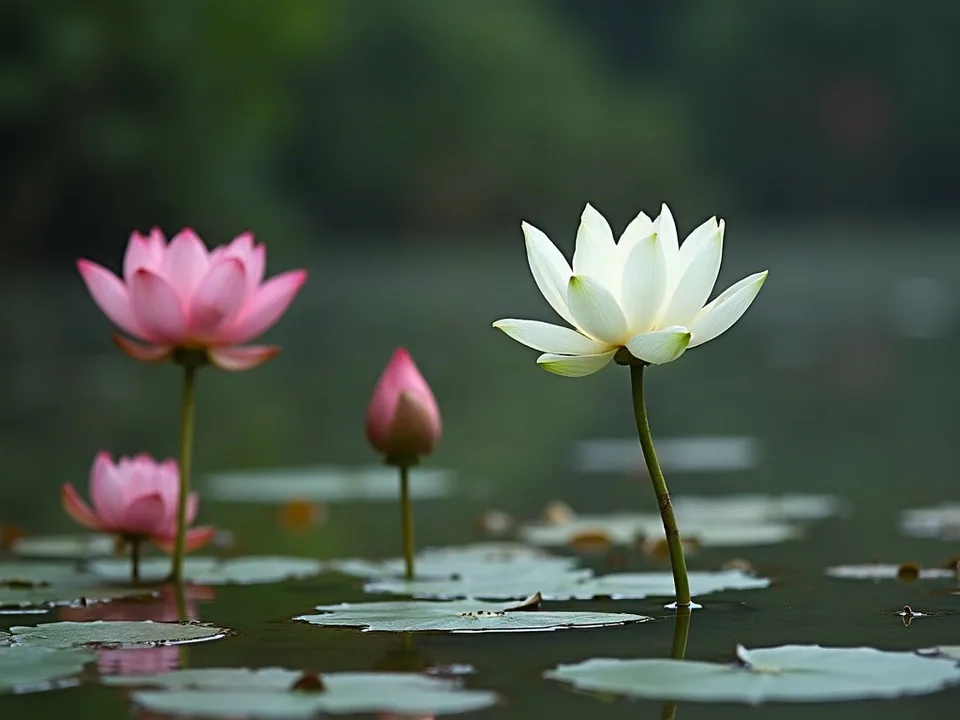
Another name for the peony is the "flower of wealth and rank." This phrase is often traced back to "On the Love of the Lotus" (Ai Lian Shuo), a short essay by the Northern Song scholar Zhou Dunyi [1]. The edition referenced here dates the essay to 1063 [1]. As its title suggests, the piece is really about the author's affection for the lotus, but within it he describes the peony as "the peony is the flower of wealth and rank among flowers" [1], a judgment that places the peony above all others in splendor and status.
The word fuki, or "wealth and rank," is generally understood to mean more than simply having money. It evokes a figure of high standing, comfortable circumstances, and commanding presence, with the flower standing in for that kind of person. As we saw in the previous section, the poems tell us that everyone in the Tang capital, from princes and officials to ordinary people, was captivated by the peony [3]. In "On the Love of the Lotus," Zhou Dunyi likened the peony to wealth and rank with the line "the peony is the flower of wealth and rank among flowers" [1]. This passage is often cited as a key example of the link between the peony and the idea of wealth and status.
In Luoyang, Only the Peony Was Called "the Flower"
During the Northern Song period, Luoyang was renowned as the leading source of fine peonies. In 1034, the scholar Ouyang Xiu recorded this in "An Account of the Peonies of Luoyang" (Luoyang Mudan Ji) [4]. In it, he writes that peonies from Luoyang are "now the finest under heaven," jin wei tianxia diyi [4]. What's especially interesting is how the people of Luoyang spoke about flowers. According to Ouyang Xiu, they called other flowers "fruit-tree flowers," but reserved the plain word "flower," with no qualifier at all, for the peony alone [4].
Ouyang Xiu explains that this was because people felt the peony was the only flower truly deserving of the name "flower" under heaven [4]. For the people of Luoyang, the peony was so clearly the flower that it needed no further description to be understood. The Tang poets' "king of a hundred flowers" [2], Zhou Dunyi's "flower of wealth and rank" [1], and Ouyang Xiu's "finest under heaven" [4]: across the centuries, the peony has repeatedly been singled out in words as a flower apart.
Flower Terminology in Luoyang
- Guozihua (fruit-flowers)
- Hua (flower)
- The only flower truly worthy of the name under heaven is the peony alone
Arriving in Japan as a Medicinal Herb
So when and how did the peony reach Japan? As a plant, the peony is native to China, with the botanical name Paeonia × suffruticosa Andrews. In ancient China, its root bark was used medicinally, and ornamental cultivation is said to date back to the 4th century [6]. Other sources note that by the Tang dynasty, in the 8th century, it was being grown as a garden plant [7]. Both its medicinal use and its ornamental history, in other words, trace back to ancient China.
When it arrived in Japan, it was likewise first valued as medicine. Osaka Municipal Nagai Botanical Garden states that it arrived as a medicinal plant during the Nara period and was later planted at various temples in Nara [7]. Kumamoto University's School of Pharmaceutical Sciences Medicinal Plant Garden, on the other hand, dates its arrival to around the Heian period, or the early Heian period [6]. The sources disagree on the exact timing. Both agree, however, that the part used medicinally was the root bark, known in traditional medicine as botanpi [6]. Drying the root bark for use as medicine was the peony's first role in Japan [6, 7].
Its arrival, its cultivation, and its first appearance in literature are three separate events, and the dates don't necessarily line up. The time it arrived as a medicinal herb and the time it first appears in writing as an admired flower are not necessarily the same. In the next section, we'll look at the peony's earliest appearance in Japanese literature.
Sugawara no Michizane's Poem on a Temple's White Peony
The oldest confirmed appearance of the peony in Japanese literature is a poem by Sugawara no Michizane (845 to 903). According to a doctoral dissertation from Nagoya University, this is the poem "White Peony at Hokke Temple" (Hokkeji Hakubotan), found in volume four of Kanke Bunsō [5]. It's a poem about a white peony blooming at a temple. Cultivation and appreciation of the peony in Japan are said to date back at least to the Heian period [5]. We can glimpse here how the peony, once brought over as a medicinal herb, had come to be admired as a flower in temple gardens.
From the Kamakura period onward, the Japanese view of the peony drew even closer to its Chinese roots. The same dissertation argues that as Song and Yuan thought and Zen Buddhism spread to Japan, peonies came to be cultivated and admired in temples as well [5]. It states that images inherited from the Tang dynasty, "king of a hundred flowers," "flower of wealth and rank," and kokushoku tenkō, were shared among the Gozan Zen monks [5]. Kokushoku tenkō means a beauty that represents the whole nation, paired with a fragrance that seems to come from heaven. Through the poems and writings of these monks, China's regard for the peony spread into Japan as well.
Peonies Blooming in Edo-Period Tattoos
We can trace the peony's appearance in Japanese tattoos back to ukiyo-e prints from the Edo period [10]. Utagawa Kuniyoshi's series Tsūzoku Suikoden Gōketsu Hyakuhachinin no Hitori ("One of the 108 Heroes of the Popular Water Margin") depicts the heroes of the Chinese novel Water Margin. A doctoral dissertation by Nakayama Sota catalogues the tattoo designs shown in this series. In it, the design for the character Rōshi Enseki, or Lang Zi Yan Qing, is listed as "karajishi botan," a Chinese lion paired with peonies, a figure whose tattoo is also mentioned in the original novel [8].
What this tells us is simply that the peony was used as a tattoo motif in Edo-period ukiyo-e [8, 10]. The combination of lion and peony in Yan Qing's tattoo has its own backstory, which we'll cover in a separate article. Here, our focus is on the meanings that have been attached to the peony itself.
The Meanings Carried by a Single Peony in Wabori
Let's lay out everything we've covered so far like entries in a reference guide. First, "king of a hundred flowers": a king who arrives late, blooming after every other flower has scattered, with a splendor nothing else can rival and a scent said to be the finest of all [2]. Second, "wealth and rank": the character Zhou Dunyi gave the peony in "On the Love of the Lotus," the flower of wealth and rank among flowers [1]. Third, "splendor that drove a capital wild": the scene Bai Juyi describes, the whole city swept up in the twenty days the flowers bloomed [3]. And fourth, "finest under heaven": the singular status Ouyang Xiu records, where the people of Luoyang called the peony, and only the peony, "the flower" [4].
These are the meanings that classical literature and art have assigned to the peony over the centuries. That doesn't mean a single peony in wabori carries one fixed, universally agreed meaning. The symbolism found in the classics and the meaning a person brings to their own tattoo are two different things. Some people layer in wishes for wealth, happiness, or a kind of commanding beauty, while others simply love the shape of the flower. Once you know where these meanings come from, you're free to decide for yourself what the flower means to you.
There's a lot of range in how it can be drawn, too. In wabori, peonies are often shown with their many layered petals separated by bold outlines, with shading in graded black ink used to suggest depth. Red and pink are the most common colors, but white or a single shade of black ink are options as well. There's classical precedent for white peonies too, as in Michizane's poem "White Peony at Hokke Temple" [5]. Whether you set a single full bloom large across the skin or add buds and leaves for a sense of movement will change the whole impression.
Meaning of Peony Tattoos
- King of a Hundred Flowers
- Pi Rixiu, "Peony" [2]
- Flower of Wealth and Rank
- Zhou Dunyi, "On the Love of the Lotus", 1063 [1]
- Splendor that Captivated the Capital
- Bai Juyi, "Peony Fragrance" [3]
- Finest Under Heaven
- Ouyang Xiu, "Record of Luoyang Peonies", 1034 [4]
Things to Think About Before Choosing a Peony
Besides the peony, cherry blossoms and chrysanthemums are also common flower motifs in wabori. There's no single right answer for which to choose, but the peony has a character the others don't share. As Bai Juyi wrote, "the flowers bloom and fall over twenty days" [3], the peony is a flower whose own full bloom takes center stage. If you want to carve a bold, fully opened flower into your skin, the peony suits that feeling well. Its associations with wealth and rank, and with being "first under heaven," also make it easy to connect to your own milestones or wishes.
When it comes to actually getting the tattoo, the final result will depend a lot on how finely the overlapping petals are rendered, whether you use color or stick to a single shade of black, and where on the body you place it. The peony's bloom is large and rounded, which makes it well suited to following the natural curve of the shoulder, arm, or back. The impression it leaves will also shift depending on your build, the size of the design, and the artist's composition. If there's a particular meaning you want to express or a style you're drawn to, share that with your tattoo artist during the consultation. Use what you've learned about the peony's history as a starting point, and choose the bloom that fits what you want to carry with you.
FAQ
Why is the peony called the "king of a hundred flowers"?
The Tang-dynasty poet Pi Rixiu's poem "Peony" includes the line "its beautiful name is called king of a hundred flowers," using the term baika-ō for the peony. The poem describes a flower that blooms only after all the others have scattered, with a splendor nothing else can match and a scent said to rank first among all flowers, and this is one of the oldest known uses of the name.
Where does the name "flower of wealth and rank" for the peony come from?
The Northern Song scholar Zhou Dunyi wrote in "On the Love of the Lotus" (1063) that "the peony is the flower of wealth and rank among flowers," likening it to wealth and status. Bai Juyi's poetry also records princes and nobles flocking to view peonies in the Tang capital, so the flower had long been tied to a glamorous, aristocratic culture.
When did the peony arrive in Japan?
Sources disagree on the exact timing. Some say it arrived as a medicinal plant during the Nara period, while others place its arrival around, or at the start of, the Heian period. The oldest confirmed appearance in literature is "White Peony at Hokke Temple," a Heian-period poem by Sugawara no Michizane.
What does it mean to get only a peony in wabori?
Classical symbolism associates the peony with the king of a hundred flowers, wealth and rank, and a splendor considered finest under heaven. That said, a single peony doesn't carry one fixed, universally agreed meaning, and you're free to decide what wishes you want it to represent. Try sharing what you'd like the tattoo to express with your artist during the consultation.
References
- [1] 周敦頤. 愛蓮說. (維基文庫, 1063). Link
- [2] 皮日休. 牡丹. (古詩文網, 唐代). Link
- [3] 白居易. 牡丹芳. (古詩文網, 唐代). Link
- [4] 欧陽修. 洛陽牡丹記. (識典古籍, 1034). Link
- [5] 武頼. 景徐周麟の花鳥詩文における詩想と思想. (名古屋大学学術機関リポジトリ, 2025). Link
- [6] 熊本大学薬学部薬用植物園. ボタン. (熊本大学薬学部薬用植物園 薬草データベース). Link
- [7] 大阪市立長居植物園. ボタン園. (大阪市立長居植物園). Link
- [8] 中山創太. 歌川国芳研究 -19世紀浮世絵における文化交渉のかたち-. (関西大学学術リポジトリ, 2014). doi:10.32286/00000241. Link
- [9] 中山創太. 関西大学学術リポジトリ. (関西大学学術リポジトリ, 2014). Link
- [10] 歌川国芳. 通俗水滸傳豪傑百八人之一個・浪子燕青 文化遺産オンライン. (文化庁文化遺産オンライン, 19世紀). Link
Japanese tattoo in Tokyo
Turn Japanese tattoo history into a custom design
Explore traditional motifs, modern Japanese compositions, and the consultation process with our English-friendly Ueno studio.
Related Articles
The Meaning of Lotus Tattoos and How the Flower Appears in Wabori
Lotus tattoos are often described as a flower that "blooms pure from the mud." Yet this meaning shifts slightly depending on the source: Buddhist scripture, Japanese Buddhist art, and the Chinese essay "Ai Lian Shuo." Tracing these sources, this article looks at what the lotus means and the role the flower plays within wabori.
2026.11.02
Wabori Color Basics: Sumi and Vermilion, and How Yellow, Green, and Blue Were Used
What has guided the choice of colors in wabori (traditional Japanese tattooing)? Drawing on dated, documented sources, an English-language record from 1902, Kuniyoshi's Suikoden ukiyo-e prints, and pigment analyses of woodblock prints, we trace how sumi (dark ink), vermilion, yellow, green, and blue have been used. This is not a fixed color chart, but the basic combinations that emerge from the sources.
2026.11.02
The Meaning in Wabori Figure Motifs: A Field Guide from Suikoden to Fudo Myoo
Kumonryu Shishin, Benkei, Fudo Myoo, Sukeroku. Every human figure in wabori comes from a story or a belief behind it. A sword in hand, an angry face, both change meaning once you know the scene they come from. Drawing on ukiyo-e and museum sources, this is a field guide to what these figure motifs mean.
2026.10.19