The Meaning in Wabori Figure Motifs: A Field Guide from Suikoden to Fudo Myoo
Published · Updated
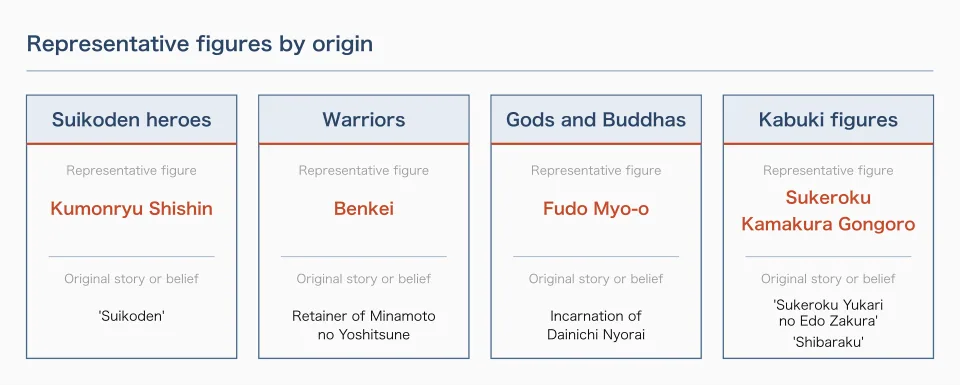
Kumonryu Shishin, Benkei, Fudo Myoo, Sukeroku. Every human figure in wabori comes from a story or a belief behind it. A sword in hand, an angry face, both change meaning once you know the scene they come from. Drawing on ukiyo-e and museum sources, this is a field guide to what these figure motifs mean.
Figure Motifs Draw Their Meaning from the Original Story
Alongside creatures like dragons and koi, wabori (traditional Japanese tattooing) also features designs built around human figures. A figure motif can't be separated from the story or belief it comes from. The meaning of a sword in hand or an angry expression depends on what that figure was doing in the original tale. Knowing what the figure actually did, before you choose the design, helps you feel settled with it once it's on your skin. This article sets technique aside and focuses only on what each figure means.
From here, we'll group the figures by where they come from: heroes from the Chinese novel Suikoden (Water Margin), Japanese warriors, Buddhist deities, and characters who appear on the kabuki stage. This grouping is one we chose for this article, simply to make comparison easier. For each figure, we'll explain their role in the original story, drawing on museum collection notes and official kabuki information. If one figure catches your interest, feel free to jump straight to that section.
Representative figures by origin
- Suikoden heroes
- Representative figure: Kumonryu Shishin
- Original story or belief: Suikoden
- Warriors
- Representative figure: Benkei
- Original story or belief: Retainer of Minamoto no Yoshitsune
- Gods and Buddhas
- Representative figure: Fudo Myo-o
- Original story or belief: Incarnation of Dainichi Nyorai
- Kabuki figures
- Representative figures: Sukeroku; Kamakura Gongoro
- Original stories: Sukeroku Yukari no Edo Zakura; Shibaraku
Full-Body Tattoos and Their Deep Ties to Woodblock Prints
Curator notes from the University of Oregon Libraries and the university's art museum explain that the full-body tattooing that spread across Japan in the 19th century was deeply tied to the culture of woodblock printing[1]. A major focus of that explanation is the Chinese novel Suikoden (Water Margin). Several of the story's heroes are described as carrying large decorative tattoos on their backs[1]. In the early 19th century, Katsushika Hokusai drew tattoo designs in the illustrations he created for a Japanese translation of the novel[1].
Utagawa Kuniyoshi then released multicolor woodblock prints of Suikoden heroes in the 1820s[1]. The same source explains that these prints led to the trend for full-body tattoos[1]. The National Museum of Asian Art, part of the Smithsonian Institution, holds one print from Kuniyoshi's series Tsuzoku Suikoden Goketsu Hyakuhachinin no Hitori, depicting Kumonryu Shishin and Chokankko Chintatsu[3]. It was made between 1827 and 1830, in ink and color on paper, measuring 37 cm by 26.6 cm. The museum has tagged this work with the subject term 'tattoo'[3].
The Suikoden heroes, Benkei, Sukeroku, and Kamakura Gongoro featured in this article all became familiar to the public through ukiyo-e prints and theater[2, 4, 6, 7]. Some ukiyo-e were made specifically to promote kabuki performances[8]. When looking at a figure motif, it helps to picture the original print or stage scene behind it, since that makes it easier to grasp what the figure represents.
The Suikoden Heroes: 108 Outlaws Who Defied a Corrupt World
Suikoden (Water Margin) is a Chinese novel written in the 14th century. It follows 108 outlaws who rose up against authority during an age of political corruption[2]. New York's Metropolitan Museum of Art describes it as a tale of revenge by a band of outlaws against a corrupt government[9]. These heroes aren't portrayed as mere troublemakers. Their role in the story is to turn their backs on unjust power and stand together against it.
A leading example is Kumonryu Shishin. In Kuniyoshi's print, he appears alongside Chintatsu, and the museum's subject tags for the piece include 'tattoo'[3]. A four-panel nishiki-e (multicolor woodblock print) from around 1835, held by the Met, shows the heroes portrayed as kabuki actors[2]. Nakamura Shikan II appears as Kumonryu Shishin, Nakamura Utaemon III as Nyuunryu Koson Sho, and Arashi Rikan II as Rori Hakucho Chojun. However, the three actors never actually performed together on stage in Osaka; it's an imagined theatrical scene that exists only in the print[2].
The heroes' images weren't limited to bold warrior prints. A print Kuniyoshi made in 1840 looks, at first glance, like a woman relaxing in a boat. In fact, curator notes explain, it's a mitate (playful visual substitution) of the Suikoden hero Katsusenba Oteiroku[9]. Mitate is a playful technique that depicts one figure or scene by standing in for it with another. This print shows that Suikoden figures made their way not just into warrior prints, but into playful mitate images as well[9].

Benkei, the Warrior Who Stands in a Moonlit Sea
For warriors, we turn to Musashibo Benkei. As a warrior who served Minamoto no Yoshitsune, Benkei has long been a familiar figure through war chronicles, Noh, and kabuki. In January 1886, the Meiji-era ukiyo-e artist Tsukioka Yoshitoshi released 'Daimotsu Kaijo no Tsuki: Benkei' as the 14th print in his series One Hundred Aspects of the Moon[4]. According to the British Museum's description of the work, it depicts Benkei driving off the spirit of Taira no Tomomori and calming the sea at Daimotsu[4].
In this print, Benkei's role is to confront the spirit rising from the sea and calm the churning waters[4]. When choosing a Benkei motif, it helps to start with the basic fact that he's a warrior loyal to his lord. From there, deciding exactly which story and which scene you want to depict will sharpen the meaning you put into the design. A Benkei set against moon and sea points back to this specific scene from Yoshitoshi. Even with the same figure, the impression it conveys changes a great deal depending on which scene you choose.
Fudo Myoo's Sword Is Meant to Cut Through Worldly Desire
For deities, we look at Fudo Myoo. According to the Tokyo National Museum, Myoo (wisdom kings) are considered manifestations of Dainichi Nyorai (the Buddha Vairocana)[5]. Fudo Myoo's angry expression and intimidating form exist to inspire deeper faith in Buddhism[5]. In Japan, Fudo Myoo has been worshipped since the 9th century[5]. That fierce face isn't meant to frighten people; it's there to lead those who are lost toward the Buddhist teachings.
Fudo Myoo holds a sword in his right hand and a rope called a kensaku in his left. The same source explains that the sword in his right hand cuts through bonno, the worldly desires and confusion that disturb the mind[5]. The kensaku in his left hand represents saving people, pulling them up[5]. The museum is explicit that neither is a weapon meant to defeat an enemy[5]. The sword is a tool for cutting, but what it cuts isn't an outside enemy; it's the confusion within yourself.
If you read a Fudo Myoo motif as representing only strength or aggression, you drift away from its original meaning. It's about cutting through your own confusion, and reaching out a hand to those who are suffering. Knowing the meaning carried by the sword and rope means you'll be able to explain the design in your own words when someone asks about it. Since motifs of deities are rooted in faith, we recommend choosing one only after you understand what it means.
Kabuki Figures: Sukeroku and Kamakura Gongoro
Among kabuki figures, there's Sukeroku from Sukeroku Yukari no Edo Zakura. According to Shochiku's official site, Kabuki Bito (Kabuki Web), Sukeroku is the most celebrated dandy in Yoshiwara, known as the lover of Agemaki, a high-ranking courtesan[6]. At the same time, he's portrayed as a man who loves to pick fights. In truth, he's Soga Goro, and he uses fighting as a pretext to search for his family's lost sword[6]. Beneath the stylish townsman's image lies the goal of recovering a treasured family heirloom.
The other is Kamakura Gongoro from Shibaraku, considered one of kabuki's oldest plays[7]. As the villain Kiyohara no Takehira prepares to execute loyal retainers, Gongoro appears and saves them[7]. He exposes Takehira's wrongdoing, defeats his men, and exits down the hanamichi (the raised walkway through the audience) having shown off his strength[7]. The play is known for aragoto, a bold, exaggerated style of performance[7]. Gongoro's role is to help the weak and drive out evil.
Kabuki figures spread widely as images thanks to yakusha-e, actor prints. According to the Metropolitan Museum of Art, Torii Kiyonobu, founder of the Torii school, specialized in drawing popular kabuki posters and signboards[8]. His thick, flowing lines, bold volume, and flat patterns were designed to catch the eye even from a distance[8]. A woodblock print from around 1708, held by the museum, is presented as an example of this technique[8].
Decide on a Scene from the Story Before You Choose a Design
As we've seen, the meaning behind a figure motif lives in its original story or belief. For a Suikoden hero, it's defiance of unjust power. For Benkei, it's loyal service and calming the sea. For Fudo Myoo, it's cutting through worldly desire and saving others; for Sukeroku, it's Soga Goro searching for a family heirloom; for Kamakura Gongoro, it's driving out evil. Even with the same figure, what comes across changes depending on which scene you depict. Deciding on the scene, not just the figure's name, keeps the meaning you want to express from drifting.
If you're considering a figure motif, tell us during your consultation which figure you want and which scene from the story you have in mind. If there's an ukiyo-e print or stage scene you love, we can use it as a starting point. We'll go over the finer details of the design, such as placement and size, when you book. A motif chosen with its meaning in mind becomes more a part of your own story the longer you carry it.
Flow for choosing a design
- Step 1
- Choose the figure to get
- Step 2
- Learn the original story or belief
- Step 3
- Decide the scene to depict
- Step 4
- Discuss in a counseling session
FAQ
What kinds of figures appear in wabori figure motifs?
This article groups figures by where they come from. From the Chinese novel Suikoden, we cover heroes like Kumonryu Shishin; from warriors, Benkei, who served Minamoto no Yoshitsune. From deities, we cover Fudo Myoo, and from kabuki, Sukeroku and Kamakura Gongoro from Shibaraku.
Why are Suikoden heroes connected to wabori?
Several of Suikoden's heroes are described as carrying large decorative tattoos on their backs. In the early 19th century, Katsushika Hokusai drew tattoo designs for the illustrations of a Japanese translation of the novel. In the 1820s, Utagawa Kuniyoshi released multicolor woodblock prints of Suikoden heroes. Curator notes from a university library and art museum explain that 19th-century full-body tattooing was deeply tied to the culture of woodblock printing.
Is Fudo Myoo's sword a weapon for defeating enemies?
According to the Tokyo National Museum, it isn't a weapon for defeating enemies. The sword in his right hand cuts through people's worldly desires, and the kensaku (rope) in his left hand represents saving and lifting people up.
Who is Sukeroku?
He's the hero of the kabuki play Sukeroku Yukari no Edo Zakura. He's the most celebrated dandy in Yoshiwara, known as the lover of Agemaki, a high-ranking courtesan. In truth, he's Soga Goro, using fights as a pretext to search for his family's lost sword.
What should I prepare if I want a figure motif?
Decide on the figure you want and the scene from the story you have in mind; this makes the consultation go more smoothly. Even with the same figure, the impression it gives changes depending on the scene. Please share the finer design details with us when you book.
References
- [1] Glynne Walley. Tattoos in print. (University of Oregon Libraries / Jordan Schnitzer Museum of Art, 2019). Link
- [2] 不詳(館蔵品解説). Three Heroes of the Water Margin Capture the Bandit Queen Ichijōsei, from the series One Hundred Eight Heroes of the Theater Suikoden. (The Metropolitan Museum of Art, ca. 1835). Link
- [3] 歌川国芳. Shi Jin and Chen Da, from the series One Hundred and Eight Heroes of the Popular Water Margin. (Smithsonian Institution, National Museum of Asian Art, 1827-1830). Link
- [4] 月岡芳年. Daimotsu kaijo no tsuki: Benkei, from the series One Hundred Aspects of the Moon. (The British Museum, 1886). Link
- [5] 東京国立博物館. 不動明王立像. (ColBase 国立文化財機構所蔵品統合検索システム, 不詳). Link
- [6] 松竹. Sukeroku yukari no Edo zakura. (KABUKI WEB, 2023). Link
- [7] 松竹. Shibaraku. (KABUKI WEB, 2025). Link
- [8] 鳥居清信Iに帰属. Kabuki Actor. (The Metropolitan Museum of Art, ca. 1708). Link
- [9] 歌川国芳. Water Scene. (The Metropolitan Museum of Art, 1840). Link
Japanese tattoo in Tokyo
Turn Japanese tattoo history into a custom design
Explore traditional motifs, modern Japanese compositions, and the consultation process with our English-friendly Ueno studio.
Related Articles
Wabori Color Basics: Sumi and Vermilion, and How Yellow, Green, and Blue Were Used
What has guided the choice of colors in wabori (traditional Japanese tattooing)? Drawing on dated, documented sources, an English-language record from 1902, Kuniyoshi's Suikoden ukiyo-e prints, and pigment analyses of woodblock prints, we trace how sumi (dark ink), vermilion, yellow, green, and blue have been used. This is not a fixed color chart, but the basic combinations that emerge from the sources.
2026.11.02
Wabori Glossary: Core Terms from Sujibori to Hikae
During a wabori consultation, you'll often hear unfamiliar words like sujibori (outline) and hikae (chest panel). This article is a quick-reference glossary you can pull up on the spot. It gives short definitions for sujibori, bokashi, nuki-bori, gaku-bori, mikiri, hikae, and sleeve lengths, with English terms included for visitors from abroad.
2026.10.12
Gaku Backgrounds in Wabori: How Waves, Clouds, Wind, Rock, and Flame Are Used
In wabori, the background surrounding the main motif is called the gaku. It shows where the main motif stands and how it moves, giving the design depth. Drawing on ukiyo-e prints and museum collections, we look at waves, clouds, wind, rock, and flame one by one, exploring each element's role and its fit with the main motif.
2026.09.21