Gaku Backgrounds in Wabori: How Waves, Clouds, Wind, Rock, and Flame Are Used
Published · Updated
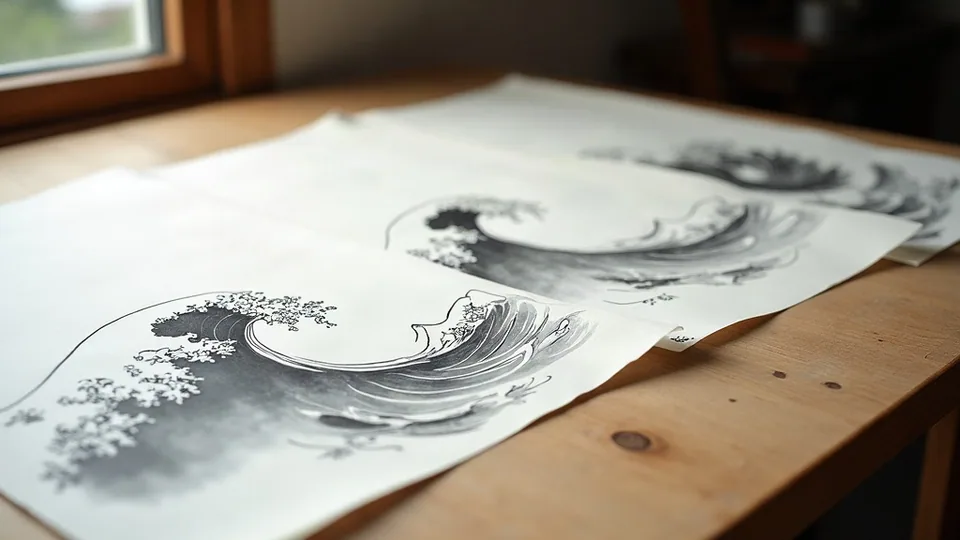
In wabori, the background surrounding the main motif is called the gaku. It shows where the main motif stands and how it moves, giving the design depth. Drawing on ukiyo-e prints and museum collections, we look at waves, clouds, wind, rock, and flame one by one, exploring each element's role and its fit with the main motif.
Gaku: The Stage Set That Gives the Main Motif Place and Motion
In wabori, the background that surrounds the main motif is called the gaku. The term is understood as gaku even among English-speaking enthusiasts. The elements of the gaku include clouds, rock, waves, swirls, and wind. The gaku shows where the main motif stands and which way it moves. It works like a stage's backdrop or floor.
The background is chosen to suit the main motif. This article takes up five gaku elements in turn: waves, clouds, wind, rock, and flame. We look at the role each one plays and what kinds of main motifs they have traditionally been paired with, drawing on ukiyo-e prints and museum collections.
One note on terminology: some tattoo artists call a wind gaku kazebori and a cloud gaku kumobori, but naming varies by lineage and artist. In this article, we keep to the plain element names: wave, cloud, wind, rock, and flame. For visitors from abroad, we also add the romanized terms nami, kumo, kaze, iwa, and honoo. In a consultation, naming the element itself is all you need to be understood.
Dragon and background composition
- Clouds
- kumo
- Flame (behind)
- honoo
- Wind
- kaze (left and right)
- Rocks
- iwa
- Waves
- nami
Wave (nami): Lending the Main Motif Momentum
Wave is one of the most common elements found in the gaku. As a reference point, consider Katsushika Hokusai's Under the Wave off Kanagawa. It is held by the Metropolitan Museum of Art, made around 1830 to 1832, a woodblock print measuring 25.1 by 37.8 cm [4]. The museum's commentary notes that the claw-like shapes of the great wave recall mythical dragons or dangerous beasts [4]. This shows that waves have long been drawn not as mere water, but as living forms with fangs.
The same commentary notes that placing Mount Fuji in the hollow of the rough wave crest creates a dramatic sense that both the three fishing boats and Mount Fuji are about to be swallowed by the wave [4]. The wave in a gaku performs this same function for the main motif. The direction the wave crest breaks determines whether the main motif is being pushed, or cutting through the wave itself. Our view is that the wave lends the main motif momentum. This is a visual reading based on the imagery, not a fixed or official meaning.
As one example of a main motif paired with waves, there is a 19th-century tsuba, or sword guard. The Metropolitan Museum of Art holds a wave and dragon tsuba, 7.1 cm high and 6.8 cm wide, with a gold dragon amid the waves on the front, and waves and clouds on the back [5]. The commentary notes that the wave's spray is highlighted in gold [5]. A dragon emerging from the waves is a composition that has worked even on a piece of metal small enough to fit in one's palm. Placing waves around a dragon in wabori sits squarely within this visual tradition.
Cloud (kumo): Lifting the Main Motif into the Sky
Cloud is the background element that gives the main motif height and depth. On the same wave and dragon tsuba, waves and clouds appear together on the reverse side [5]. The museum's commentary notes that the space between the clouds and waves is filled with a metalwork finish called nanako-ji, or fish-roe ground, while the wave spray is highlighted in gold [5]. Clouds and waves share a single surface, linked by a different texture in between. Clouds and waves coexisting on a single back in wabori follows this same idea.
Clouds make the main motif look as though it is in the sky. We think clouds suit a main motif that floats in the air or travels across the sky. This is a visual interpretation drawn from the imagery, not a rule that clouds must always signify height.
Clouds also work to connect other elements. Clouds above waves, clouds behind rock, clouds around flame: in each case, they soften the boundary between different elements. If the main motif is a dragon, hiding part of its body behind clouds lets the viewer imagine the unseen part, making the body feel longer than it actually is. One reason clouds appear so often in the gaku is this work of concealing while still revealing.
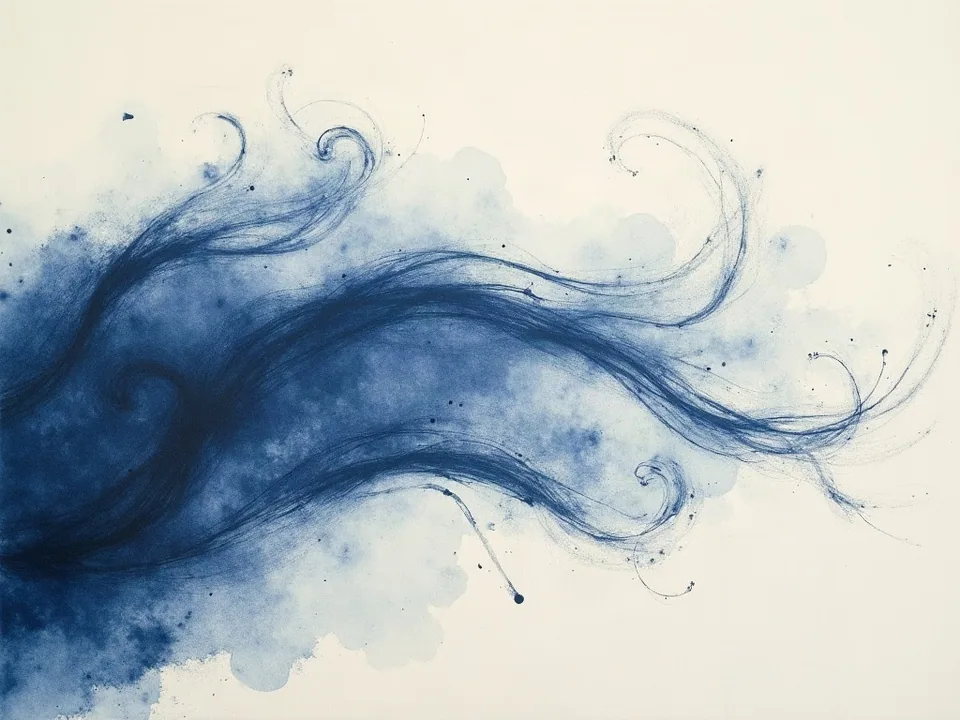
Wind (kaze): Showing a Force With No Shape
Wind has no shape of its own, so it is expressed through the movement it causes around it. The British Museum holds a hanging scroll attributed to Kawanabe Kyosai, Fujin Releasing Wind from a Sack. It was made around 1885 to 1889, in color on silk with gold, measuring 81.5 by 29.5 cm [8]. The museum's record describes it as depicting the wind god releasing wind from a sack [8]. It is an image that captures the moment an invisible force bursts into the scene. Depicting the moment wind is born, or the things it moves, is the basic approach to expressing it.
There are storm scenes too. One print from Utagawa Kuniyoshi's series One Hundred and Eight Heroes of the Popular Suikoden shows Fan Rui summoning a demon, stones, and a storm through sorcery [9]. It was made between 1827 and 1830, a multicolor woodblock print published in Edo [9]. Here, the storm is a device for showing the figure's supernatural power. It is the same in a wabori gaku: wind stirs the air around the main motif, showing that it is in the act of releasing its power right now.
Our view is that wind gives the main motif a direction of movement. Combined with waves it becomes a storm, combined with clouds it becomes a sky in motion. Wind is a light element. For a main motif that needs weight, rock, discussed next, is added to balance lightness above with weight below.
Rock (iwa): Building Ground Beneath the Main Motif
Rock carries weight and stability within the gaku. As a point of reference, look at Fudo Myoo. The Metropolitan Museum of Art holds a 12th-century wooden statue of Fudo Myoo, 162 cm tall, and the museum explains that his name means the Immovable One [7]. It also notes that the weight of his shoulders and back, carried on firmly planted legs, suits that name well [7].
A rock gaku builds ground beneath the main motif's feet and absorbs its weight. Our view is that rock makes the main motif look heavier. Where a main motif standing on clouds or wind looks as if it is floating, one standing on rock looks grounded no matter how much its body twists. This, too, is a visual reading based on the imagery, not a fixed meaning.
Rock is also an element that pairs easily with water. Water breaking against rock creates both something still and something flowing within the same gaku at once. In Kuniyoshi's print, too, Fan Rui summoned stones and a storm together [9]. Pitting a heavy element against a light one heightens the intensity of the scene. If a rock-only gaku feels too quiet, adding a waterfall or wind follows this same logic.
Flame (honoo): Releasing the Main Motif's Power Outward
Flame is the background element that shows the main motif's own power released outward. The clearest example is, again, Fudo Myoo. The Metropolitan Museum of Art introduces Fudo Myoo as the most popular of the Five Great Wisdom Kings [6]. It explains that he is typically shown holding an upright sword in his right hand and a rope called a kensaku in his left, surrounded by flames [6]. Flame is part of the iconography used to represent Fudo Myoo.
Fudo Myoo can be paired with both a rock gaku and flame. The museum's commentary describes him as surrounded by flames [6]. His feet stay still on rock, while flames burn fiercely around his body. Calm below, intense above: this contrast forms the skeleton of Fudo Myoo's gaku. It is a useful reference when adding flame to other main motifs as well.
Our view is that flame conveys the main motif's strength or heat. Flame has two possible directions, though: flame emitted from the main motif's own body, and flame as the surrounding environment. Fudo Myoo's flame belongs to the first type. When choosing flame as a gaku, deciding with your tattoo artist whether it emits from the main motif or burns around it makes the composition easier to settle. Once the direction of the flame is fixed, where to place cloud or wind also tends to fall naturally into place.
How the Ukiyo-e Picture Plane Became the Gaku on Skin
That gaku expression is deeply tied to ukiyo-e is also discussed in scholarly works. Horitaka (Takahiro Kitamura)'s Tattoos of the Floating World was published in 2003, 119 pages, and traces the parallel histories of ukiyo-e and Japanese tattooing, discussing typical ukiyo-e motifs in relation to tattoo [2]. A distinctive feature is that it places Kuniyoshi's prints alongside sketches, drawings, and tattoos by Horiyoshi III [2]. It is a book that lets you compare, with real examples, how print compositions were carried over onto skin.
Kuniyoshi's role in the popularity of tattooing is also mentioned in legal scholarship. A 2025 paper records that Kuniyoshi produced a print series based on the Suikoden, and that this series sparked a tattoo boom [10]. The outlaw heroes depicted in the prints were covered in tattoos, and the popularity of both the story and the prints is said to have contributed to the social acceptance of tattooing [10]. The Fan Rui print discussed earlier is one image from that very series [9]. Seeing the heroes standing amid storm and stone as a model for the gaku helps reveal the roots of how wind and rock came to be used.
Hokusai's wave is the same. The museum's reading of the wave crest as resembling a beast's claw [4] carries straight over into how waves are drawn in a gaku. Ukiyo-e developed the craft of packing a main motif and its background into a limited picture plane while guiding the viewer's eye. It makes sense that wabori, which places a main motif on the limited surface of a back or an arm, borrows from this craft. When choosing a gaku, bringing along a favorite ukiyo-e print is a good way to start the conversation with your tattoo artist.
First Wabori: Choosing a Background from the Main Motif and the Body Part
The background is chosen with its pairing to the main motif in mind. The order of operations is to choose the background to suit the main motif. So the main motif comes first. Is it a dragon, a tiger, or Fudo Myoo? Once the main motif is set, a direction begins to appear: waves or wind for a main motif in motion, clouds for one in the sky, rock for one that stands still, flame for one that releases power. None of these are absolute rules. They are affinities built up through traditional iconography and the practice of tattoo artists over time.
Next, consider where on the body you will tattoo, and how far it will extend. A full back and an upper arm offer completely different amounts of space for a gaku. If you already have tattoos, how the new gaku connects to them also shapes its design. Sort out four things, your main motif, the body part, any existing tattoos, and the range you want covered by the time it is finished, and bring them to your tattoo artist. The surest way to discuss the background is to work it out together while sketching the composition on the spot.
If you want to read one book to prepare, Japanese Tattoos: History * Culture * Design, by Brian Ashcraft and Hori Benny, is a good entry point. Published in 2016, 160 pages, it includes over 350 tattoo photographs along with interviews with tattoo artists and their clients [3]. It places Japanese tattoo imagery and kanji within their historical and cultural context, so readers can understand what they mean [3]. Since it is in English, you can recommend the same book to visitors from abroad as well. Checking how a gaku actually looks in real photographs before your consultation helps the conversation move faster.
FAQ
What does gaku mean in wabori?
It refers to the background that surrounds the main motif. It is made up of elements like clouds, rock, waves, swirls, and wind, and its role is to give the tattoo depth and expanse. The term gaku is understood even among English-speaking enthusiasts.
Is there a fixed rule that a dragon must have clouds, or that a koi must have waves?
It is not an absolute rule. These are affinities built up through traditional iconography and the practice of tattoo artists. You choose a background that suits the main motif's character in consultation with your tattoo artist.
Should I decide on the background myself before consulting a tattoo artist?
There is no need to decide on the background on its own beforehand. It is more reliable to first settle on the main motif, bring along information on which part of the body and how large an area you want tattooed, and whether you already have tattoos, and then work out the composition together with your tattoo artist during the consultation.
How should I describe the gaku elements in English?
The background as a whole is often understood simply as gaku, and the romanized terms nami (wave), kumo (cloud), kaze (wind), iwa (rock), and honoo (flame) usually get the point across. To be safe, you can add the English words too: waves, clouds, wind, rocks, and flames.
References
- [2] Takahiro Kitamura, Katie M. Kitamura. Tattoos of the Floating World: Ukiyo-e Motifs in the Japanese Tattoo. (Hotei Publishing, 2003). Link
- [3] Brian Ashcraft, Hori Benny. Japanese Tattoos: History * Culture * Design. (Tuttle Publishing, 2016). Link
- [4] Katsushika Hokusai. Under the Wave off Kanagawa (Kanagawa oki nami ura), also known as The Great Wave, from the series Thirty-six Views of Mount Fuji (Fugaku sanjūrokkei). (The Metropolitan Museum of Art, ca. 1830–32). Link
- [5] Tokinobu. Sword Guard (Tsuba) Depicting Dragon Between Waves(波龍図鐔). (The Metropolitan Museum of Art, 19世紀). Link
- [6] 不詳. Blade and Mounting for a Double-Edged Dagger (Ken). (The Metropolitan Museum of Art, 刀身は12世紀後半〜13世紀前半、拵えは14世紀). Link
- [7] 不詳. Fudō Myōō (Achala Vidyaraja). (The Metropolitan Museum of Art, 12世紀). Link
- [8] 河鍋暁斎とされる. Fujin the wind god releasing wind from his bag. (The British Museum, 1885–1889頃). Link
- [9] 歌川国芳. print, One of the 108 Heroes of the Popular Water Margin. (The British Museum, 1827–1830). Link
- [10] Yusuke Tsuzuki. An Inkling of an Idea: A Comparison of Tattoo Regulation Between the U.S. and Japan. (Asian-Pacific Law & Policy Journal, 2025). Link
Japanese tattoo in Tokyo
Turn Japanese tattoo history into a custom design
Explore traditional motifs, modern Japanese compositions, and the consultation process with our English-friendly Ueno studio.
Related Articles
Wabori Color Basics: Sumi and Vermilion, and How Yellow, Green, and Blue Were Used
What has guided the choice of colors in wabori (traditional Japanese tattooing)? Drawing on dated, documented sources, an English-language record from 1902, Kuniyoshi's Suikoden ukiyo-e prints, and pigment analyses of woodblock prints, we trace how sumi (dark ink), vermilion, yellow, green, and blue have been used. This is not a fixed color chart, but the basic combinations that emerge from the sources.
2026.11.02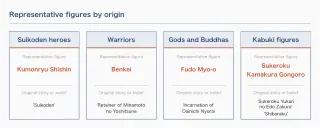
The Meaning in Wabori Figure Motifs: A Field Guide from Suikoden to Fudo Myoo
Kumonryu Shishin, Benkei, Fudo Myoo, Sukeroku. Every human figure in wabori comes from a story or a belief behind it. A sword in hand, an angry face, both change meaning once you know the scene they come from. Drawing on ukiyo-e and museum sources, this is a field guide to what these figure motifs mean.
2026.10.19
Wabori Glossary: Core Terms from Sujibori to Hikae
During a wabori consultation, you'll often hear unfamiliar words like sujibori (outline) and hikae (chest panel). This article is a quick-reference glossary you can pull up on the spot. It gives short definitions for sujibori, bokashi, nuki-bori, gaku-bori, mikiri, hikae, and sleeve lengths, with English terms included for visitors from abroad.
2026.10.12