The Meaning of Lotus Tattoos and How the Flower Appears in Wabori
Published · Updated
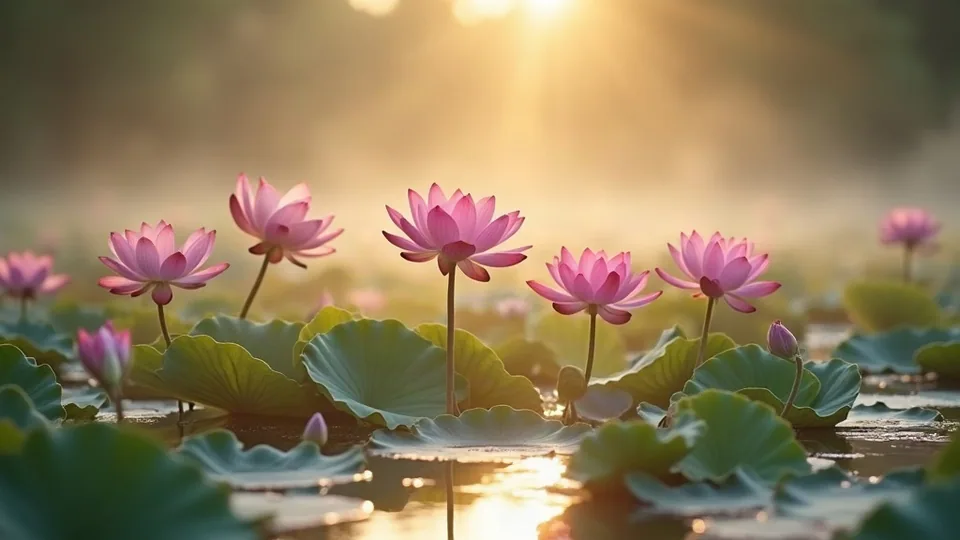
Lotus tattoos are often described as a flower that "blooms pure from the mud." Yet this meaning shifts slightly depending on the source: Buddhist scripture, Japanese Buddhist art, and the Chinese essay "Ai Lian Shuo." Tracing these sources, this article looks at what the lotus means and the role the flower plays within wabori.
Where "Blooms Pure from the Mud" Comes From
When you look into the meaning of lotus tattoos, you often find the phrase "it blooms pure even from the mud." It's a memorable image, but it doesn't come from a single scripture. Buddhist sutras, Japanese Buddhist art, and Chinese writings have each described the lotus in their own words.
The famous line "emerging from the mud yet untainted by it" comes from Zhou Dunyi's essay "Ai Lian Shuo" (On the Love of the Lotus) [3]. Meanwhile, the Pali Buddhist text Theragatha 15.2 describes the lotus as something "born in water, unwetted by water" [1]. The Kyoto National Museum explains that the lotus has long been seen as a sacred flower in Buddhism because it grows pure from deep, muddy wetlands [2].
Even though it's the same flower, what the lotus is compared to differs by source: purity, a mind untouched by the world, the Buddhist Pure Land, spiritual enlightenment, a person of high virtue, and more [1, 2, 3, 8]. This article walks through how each source describes the lotus, one by one. From there, we'll look at the role the flower plays within wabori.
The "Water-Repelling Flower" in Buddhist Scripture
One of the early Buddhist texts, Theragatha 15.2, offers a striking lotus metaphor. According to the English translation, just as a lotus born in water is not wetted by water, so the Buddha, born into the world, is not stained by the world [1]. What's being compared here isn't mud, but water. The lotus is depicted as a flower that grows within water yet is never clung to by it.
Commentary accompanying this translation notes that the lotus metaphor has long been used to express the Buddha's transcendence and his freedom from attachment [1]. Transcendence here means standing beyond the gains, losses, and confusions of the world. Rather than turning away from the world, the image is of staying within it while remaining unswayed. That's the figure the lotus is mapped onto.
For anyone who wants their lotus tattoo to carry a sense of purity or an unshaken mind, this verse offers a meaningful touchstone. It resonates deeply with the wish to stay true to oneself, undisturbed by one's surroundings. If you're putting into words why you want a lotus, this metaphor is worth remembering.
The Lotus in Japanese Buddhist Art
The Kyoto National Museum explains that the lotus has long been seen as a sacred flower in Buddhism because it grows pure from deep, muddy wetlands [2]. It further notes that lotus ponds and lotuses blooming on the water's surface symbolize the Buddhist Pure Land [2]. The Pure Land refers to the pure realm where a Buddha resides. Beyond purity, the lotus also came to represent the very shape of the world one should aspire toward.
Alongside this explanation, the museum introduces the "Ichiji Rendai Hokekyo," a copy of the twenty-second of the twenty-eight chapters of the Lotus Sutra [2]. This commentary was written by Eikei Akao in a 1995 article [2]. It shows how deeply sutras and the lotus have been intertwined within Japanese Buddhist art.
The lotus also became a subject for calligraphy. The Metropolitan Museum of Art holds a calligraphic work titled "Lotus," ink on paper, produced in Japan around 1663 to 1664 [8]. It's a collaborative piece by three monks, Yinyuan Longqi, Muan Xingtao, and Jifei Ruyi, and the museum explains that the lotus, emerging pure from muddy water, symbolizes purity and spiritual enlightenment [8]. The image linking the lotus to enlightenment appears in works like this one as well.
The Lotus Compared to Peony and Chrysanthemum
How does the lotus, a popular flower in wabori alongside peony and chrysanthemum, differ from them? Zhou Dunyi's "Ai Lian Shuo" offers a clue. According to the Kyoto National Museum's translation, this essay likens the chrysanthemum to a recluse, the peony to one of wealth and rank, and the lotus to a junzi, a person of noble virtue [3]. A recluse is someone who lives quietly apart from society, while a junzi is a person of high moral character.
Peony and chrysanthemum have each built up their own imagery within art. The Kyoto National Museum describes the peony, native to China, as the "king of flowers," traditionally representing wealth and rank [9]. On the chrysanthemum, it introduces the legend of Kikujido, who gained eternal youth by drinking dew that collected on chrysanthemum petals [10]. Patterns of flowing water and chrysanthemum, symbolizing longevity, appeared in crafts such as 14th-century bronze mirrors [10].
Put side by side, the peony has long been tied to wealth and high status, the chrysanthemum to longevity and quiet living. The lotus, by contrast, carries meanings tied to the inner life and spirit: purity, an unstained mind, high virtue, and the Pure Land [1, 2, 3]. That said, these are cultural backgrounds. Once a lotus becomes a tattoo, its meaning also shifts depending on the wearer and the artist's interpretation.
The Role Flowers Play in Wabori
Understanding where flowers sit within wabori composition helps clarify how the lotus is used. Aesthetics researcher Naho Onuki interviewed three tattoo artists in their late sixties in August 2016 [4]. She also spoke with seven additional people, artists and close associates in their thirties and forties mostly based in Osaka, compiling the findings into a paper in 2018 [4].
This paper divides wabori designs into "gakubori" and "keshoubori." Keshoubori refers to designs with concrete forms, such as flowers, waves, and flames [4]. Gakubori refers to abstracted backgrounds like waves, clouds, and rocks that surround the main subject and the keshoubori elements [4]. It helps to think of the main subject and keshoubori as the content of a picture, and the gakubori as the frame around it.
Irezumi has long also been called "horimono." Noriyuki Hirai traces documents from the early modern period through the Meiji era, arguing that irezumi is neither sculpting the body nor painting on skin [5]. This research focuses on what it calls "clothing-ness," or the character of the tattoo as something worn like a garment [5].
Composition of a full-back wabori
- Main subject
- Dragon, karajishi (shishi lion), and similar
- Keshoubori
- Designs with concrete forms, such as flowers, waves, and flames
- Gakubori
- Abstract background, such as waves, clouds, and rocks, that surrounds the main subject and keshoubori
What Compositions Does the Lotus Accompany?
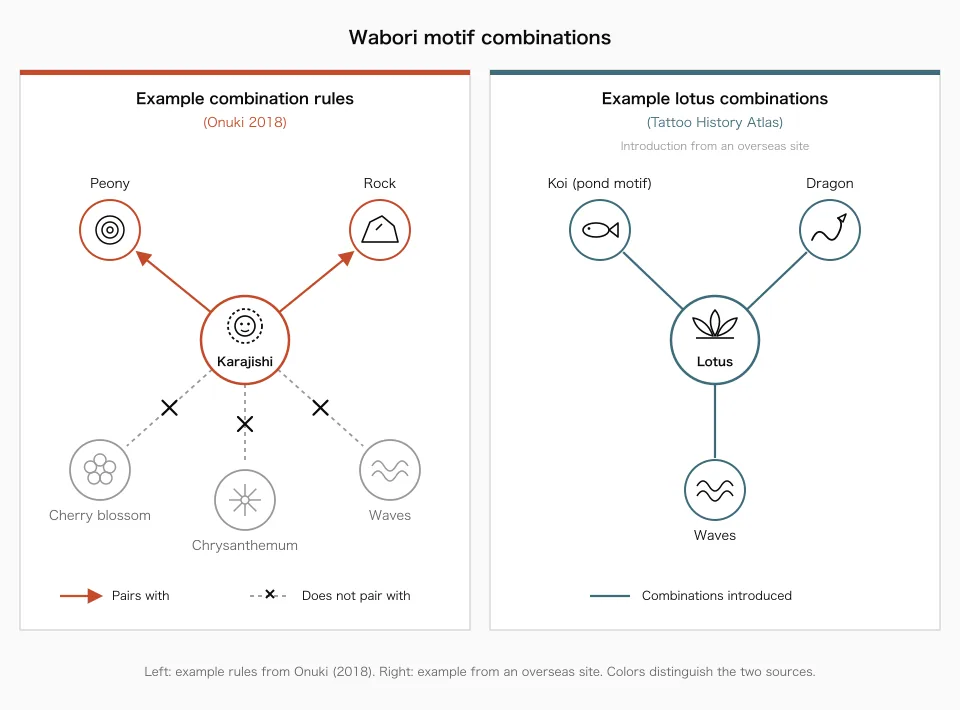
Traditional horimono follows certain conventions about which designs pair together. Onuki's paper gives the example that the shishi lion is paired with peony and rocks, but not with cherry blossoms, chrysanthemum, or waves [4]. She notes that horimono designs follow a set of established combination rules [4]. You can't simply place your favorite flower anywhere, and that's part of wabori's depth.
On how the lotus is used, the overseas tattoo history site Tattoo History Atlas explains that in classic Japanese tattooing, the lotus functions more as keshoubori than as a main subject [6]. Its role, the site explains, is to add a sense of season and Buddhist atmosphere [6]. The same site discusses koi and lotus as a pond composition, and also touches on lotus paired with dragons and lotus paired with waves [6].
Which composition actually works depends on the main motif, the placement on the body, and the overall flow of the design. Whether you want the lotus placed alongside a main subject or want the lotus itself to stand large, the artist's suggestions will differ accordingly. If you have an image in mind for your design, please bring it up when booking or during your consultation. We'll work through the composition together, combination conventions included.
What the Lotus Means Is Different for Everyone
As we've seen, the lotus doesn't carry a single fixed meaning. A mind unstained while living in the world [1], the Buddhist Pure Land [2], purity and spiritual enlightenment [8], a person of high virtue [3]: different sources tell different stories. Which meaning moves you shapes what the lotus comes to mean for you.
Some tattoo artists have put their own feelings into the lotus. Horiren I, whose artist name includes the character for lotus, ties it to the phrase "ichiren takusho" [7]. The artist's official site explains ichiren takusho as sharing joys and hardships together through life, and touches on the Buddhist idea that, after death, those bonded in this way are reborn upon the same lotus throne [7]. This is Horiren's personal conviction, expressing a resolve to devote a lifetime to the work of tattooing [7].
If you're thinking about getting a lotus, start by writing down, in your own words, why the lotus speaks to you. Those words become a valuable guide when choosing the composition, colors, and accompanying motifs. Share them with us during your consultation, and we'll help find the form that fits your intention. The meanings of other wabori motifs, including peony and chrysanthemum, are covered in our motif guide articles as well.
FAQ
What does a lotus tattoo mean?
The meaning varies by source. In the Buddhist text Theragatha 15.2, the lotus, unwetted by water, is used as a metaphor for the Buddha, born into the world yet untainted by it. In Japanese Buddhist art, it symbolizes purity and the Pure Land, and the Metropolitan Museum of Art describes it as a symbol of purity and spiritual enlightenment. In Zhou Dunyi's "Ai Lian Shuo," the lotus is likened to a junzi, a person of noble virtue.
Is "emerging from the mud yet untainted by it" a line from Buddhist scripture?
This phrase is known as a line from Zhou Dunyi's essay "Ai Lian Shuo." The metaphor in the Buddhist text Theragatha 15.2 takes the form "born in water, unwetted by water." Both speak to the lotus's purity, but they come from different sources.
How does the meaning of the lotus differ from peony or chrysanthemum tattoos?
In "Ai Lian Shuo," the chrysanthemum is likened to a recluse, the peony to one of wealth and rank, and the lotus to a junzi, a person of noble virtue. The Kyoto National Museum explains the peony as a flower representing wealth and status, and the chrysanthemum paired with flowing water as an auspicious pattern representing longevity. The meaning as a tattoo also shifts depending on the wearer and artist's interpretation, so please share what you want it to express during your consultation.
What should I discuss if I want to include a lotus in a wabori piece?
Traditional horimono follows certain combination conventions, such as pairing the shishi lion with peony and rocks. Letting us know your main motif, what you want the lotus to express, and the placement you have in mind when booking will help the composition consultation go smoothly.
References
- [1] Udayin Thera、訳:Andrew Olendzki. Udayin Thera: The Blooming Lotus (Thag 15.2). (Access to Insight / Barre Center for Buddhist Studies, 2013(最終改訂、原典はパーリ仏典)). Link
- [2] 赤尾栄慶. The Lotus Pedestal Character Lotus Sutra. (京都国立博物館, 1995). Link
- [3] 森橋なつみ. 蓮(はす)を愛する人は…. (京都国立博物館, 2022). Link
- [4] 大貫菜穂. 無辺のカンヴァスと対峙すること イレズミにおける身体と彫師の聯絡. (Core Ethics, 2018). Link
- [5] 平井倫行. 刺青は「彫る」ものであるか 日本刺青の「用語法」と「衣裳性」を中心に. (美学会『美学』, 2018). doi:10.20631/bigaku.69.2_25. Link
- [6] Tattoo History Atlas編集部(著者記載なし). Lotus Tattoo Meaning and History. (Tattoo History Atlas, 記載なし). Link
- [7] 初代 彫蓮. Dedication. (初代 彫蓮 公式サイト, 記載なし). Link
- [8] 隠元隆琦、木庵性瑫、即非如一. The Gateway Character “Lotus”. (The Metropolitan Museum of Art, 1663〜1664頃). Link
- [9] 京都国立博物館. The Peony: Flower of Wealth and Honor. (京都国立博物館, 2020). Link
- [10] 作者不詳. Mirror with Chrysanthemums, Flowing Water, and a Pair of Birds. (京都国立博物館, 14世紀). Link
Japanese tattoo in Tokyo
Turn Japanese tattoo history into a custom design
Explore traditional motifs, modern Japanese compositions, and the consultation process with our English-friendly Ueno studio.
Related Articles
What Do Wabori Motifs Mean? A Field Guide to Flowers, Dragons, Hannya, and Mythical Beasts by Category
What does the dragon represent? What does the hannya mask carry? Wabori (traditional Japanese tattoo) designs hold meanings passed down through kimono patterns, mythology, Noh theater, and ukiyo-e prints. This article sorts the main motifs into categories: flowers, dragons, snakes and koi, masks, mythical beasts, and background elements, so you can look up the meaning and origin traditionally tied to each one in a single line.
2026.10.19
Oni Tattoo Meaning vs. Hannya: Telling Them Apart by Horns and Fangs
Oni and hannya are both fearsome, horned faces, but they come from different places. Oni is a broad category shaped by beliefs about the dead and Buddhist influence, while hannya is one specific demon-woman mask used in noh theater. This article traces where each comes from, offers visual clues for telling them apart, and walks through how to decide which one to get tattooed.
2026.10.12
Wabori Color Basics: Sumi and Vermilion, and How Yellow, Green, and Blue Were Used
What has guided the choice of colors in wabori (traditional Japanese tattooing)? Drawing on dated, documented sources, an English-language record from 1902, Kuniyoshi's Suikoden ukiyo-e prints, and pigment analyses of woodblock prints, we trace how sumi (dark ink), vermilion, yellow, green, and blue have been used. This is not a fixed color chart, but the basic combinations that emerge from the sources.
2026.11.02