What Does a Karajishi Tattoo Mean? Its Difference from Komainu and Why Wabori Artists Choose It
Published · Updated
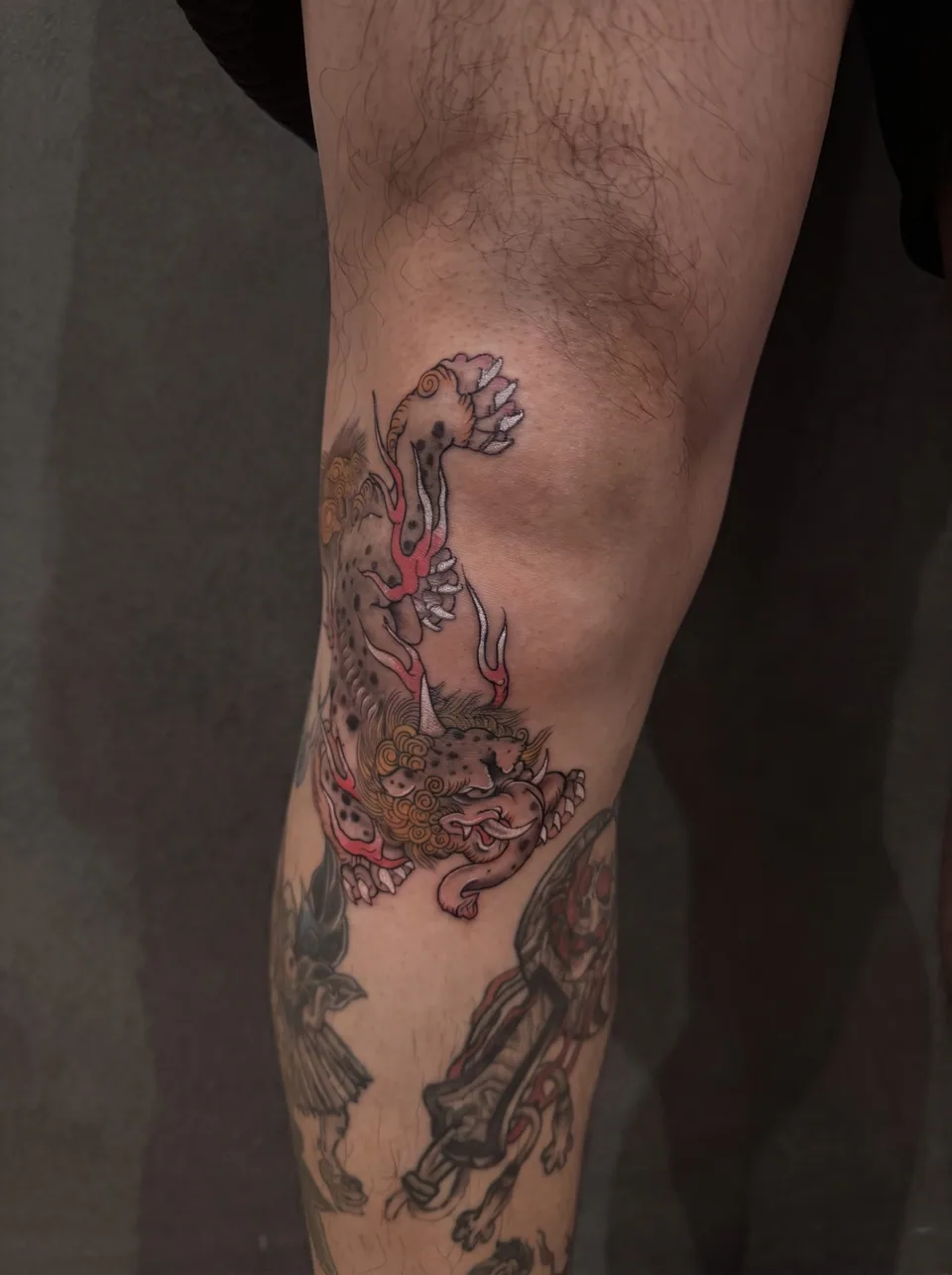
Karajishi is an imagined beast born from the lion. In Japan it has long been loved as a guardian of temples and shrines, and as a motif for armor and fusuma (sliding door) paintings [2, 4]. Drawing on museum and dictionary sources, we look at where it came from, why it carries the character for "kara" (meaning foreign), and how it came to be tattooed.
Karajishi Is Not Simply a Lion
The starting point for karajishi is a real lion. Japan Search describes karajishi as an imagined animal, created from the lion and transmitted from China [4]. Still, the karajishi you see in wabori looks quite different from a lion at the zoo. According to the Kyoto National Museum, Egypt and the Middle East produced realistic lion statues [2]. In China, far from any lion habitat, the form gradually changed and became karajishi [2]. Passed down for generations in a land without real lions to reference, the image slowly transformed into an imagined beast.
The roots go back even further west. The Nara National Museum explains that sangei, another name for the lion, is considered the prototype of what we now call karajishi [1]. Sangei is said to have originated in West Asia and traveled to China from Sasanian Persia during the Sui and Tang dynasties [1]. In China, its form appears in the patterns on the backs of mirrors and in gold and silver vessels [1].
A guide from the Agency for Cultural Affairs explains another route of transmission. A pair of beasts that guarded gates in West Asia became linked in India with the Buddhist shishiza (the lion throne on which Buddha sits), then entered China [3]. When Buddhism was introduced to Japan in the 6th century, Buddhist statues came with a pair of lions at the base of their thrones, so the lion as guardian beast is thought to have arrived together with Buddhism [3]. Japan Search also explains that karajishi is believed to have arrived with Buddhism and became established as a sacred animal [4].
The journey of the karajishi to Japan
- West Asia
- Origin of the gate-guarding beasts and the sangei
- India
- Guardian beasts merge with the Buddhist lion throne
- China
- Arrives in the Sui and Tang dynasties and changes into the karajishi
- Japan
- Arrives with Buddhism in the 6th century
Why Does It Carry the Character for "Kara"?
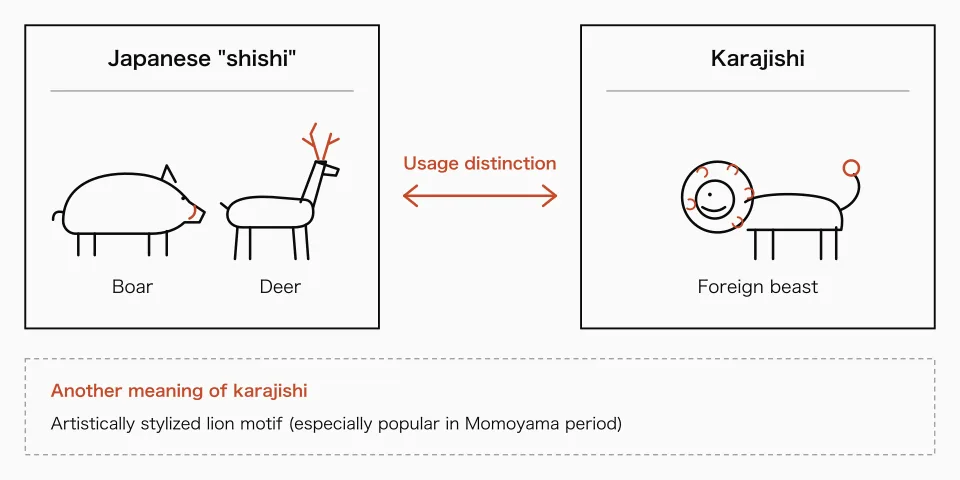
Hearing "kara," many people picture the Tang dynasty of China. Look it up in a dictionary, though, and a more everyday story emerges. According to the Seisen-ban Nihon Kokugo Daijiten, karajishi is a word for foreign-born beasts, used in contrast to shishi, the term for native animals like boar and deer [5]. In old Japan, familiar animals such as boar and deer were called shishi. Lions arriving from across the sea were then distinguished as "kara no shishi," lions of foreign origin. It helps to think of "kara" here as simply meaning "from abroad."
The same dictionary also defines karajishi as an artistically decorative version of the lion, noting it flourished especially in the Momoyama period [5]. In other words, karajishi is both the name of an animal and the name of a design pattern shaped for ornament. The old edition of the Sekai Daihyakka Jiten, in its entry on the lion, states that the image of karajishi as a fantastical beast from China is thought to have reached Japan through the esoteric Buddhist Ryokai Mandala paintings brought over in the 9th century [5]. So alongside the guardian lion that arrived with Buddhism in the 6th century, the pictorial form of karajishi as a painting model also arrived in the 9th century.
Where Do the Meanings of Protection and Warding Off Evil Come From?
The basis for seeing karajishi as a guardian deity lies in the history of temples, shrines, and Buddhist art. According to a guide from the Agency for Cultural Affairs, artifacts depicting a pair of lions as guardian beasts remain from as early as the Asuka period [3]. In the Heian period, the pairing of lion and komainu was devised, taking on the role of protecting the gods and Buddha at shrines and temples [3]. The Kyoto National Museum also explains that from the Heian period onward, lion and komainu statues were placed at the entrances and inside the halls of shrines and temples, guarding the grounds and the sacred images within [2]. Like gatekeepers, they stood at entrances, watching over important places.
Its role in warding off evil extended into the imperial court as well. Japan Search explains that in the Heian period, karajishi was treated as a ward against evil, and lion and komainu statues were placed in front of the micho (curtained seat) in the Seiryoden hall of the imperial palace [4]. This shows it was chosen to protect important places in the court, not just at temples and shrines. The images of "protection" and "warding off evil" have attached themselves to karajishi precisely because of this long history.
At temples, shrines, and in the imperial court, karajishi was a symbol that gave shape to protection and warding off evil. Getting a karajishi tattoo does not actually protect you from danger or misfortune. Still, it's only natural to want to wear the image of a guardian deity for encouragement, treating it almost like a protective charm. If you take the meaning that history has nurtured and make it your own wish, karajishi becomes a design you can live with for a long time.
The Difference from Komainu Lies in Being Its "Paired Partner"
Many people call every paired statue at a shrine a "komainu." Trace the sources, though, and you find that lion and komainu were originally two separate beings that came to form a pair. The Agency for Cultural Affairs guide explains that a pair of lions as guardian beasts appears from the Asuka period, and the combination of lion and komainu was devised in the Heian period [3]. The Kyoto National Museum has also held a special exhibition titled "Lion and Komainu," introducing how the two took on a guardian role at entrances and inside halls from the Heian period onward [2]. Komainu is the partner placed alongside the lion. As for telling them apart, the Kyoto National Museum explains that the one with a single horn on its head is called komainu, and the one without is called the lion [2]. Japan Search likewise describes the Heian-period pair placed in front of the micho in the Seiryoden, the open-mouthed one as the lion and the closed-mouthed, single-horned one as komainu [4].
Karajishi, for its part, also spread beyond its role as guardian of temples and shrines. Japan Search notes that in the medieval period it was favored as armor decoration, and in the Muromachi and Azuchi-Momoyama periods it became a motif for fusuma and byobu (folding screen) paintings in castle architecture [4]. Dictionaries also define karajishi as an artistically decorative version of the lion [5]. At temples and shrines it paired with komainu to guard entrances, while in paintings and crafts it was depicted as an independent motif in its own right.
History of shishi and komainu
- Asuka period (role at temples and shrines)
- Surviving pairs of shishi made as guardian beasts
- Heian period (role at temples and shrines)
- The shishi and komainu pairing is devised to guard the entrances and halls of temples and shrines
- Medieval period (decoration and painting)
- Karajishi used to decorate armor
- Muromachi and Azuchi-Momoyama periods (decoration and painting)
- A subject for fusuma and folding screen paintings in castles
- Edo period (decoration and painting)
- Favored by samurai families
A Powerful Beast Favored by Warriors and the Powerful
Alongside its role as guardian, karajishi also carries a symbolic face of "power." The Agency for Cultural Affairs guide explains that lion patterns from China's Tang dynasty also symbolized boundless power, akin to royal authority [3]. That strength was prized in Japan too. Japan Search explains that in the medieval period, karajishi was favored as armor decoration for its valiant appearance [4].
By the Azuchi-Momoyama period, karajishi had become the star of grand paintings adorning castle interiors. Japan Search notes that in the Muromachi and Azuchi-Momoyama periods, it became a motif for fusuma and byobu paintings in castle architecture [4]. Dictionaries also state that the decorative karajishi flourished especially in the Momoyama period [5]. Even into the Edo period, karajishi remained a favorite among the warrior class [4].
Wabori Designs and Their Ties to Ukiyo-e
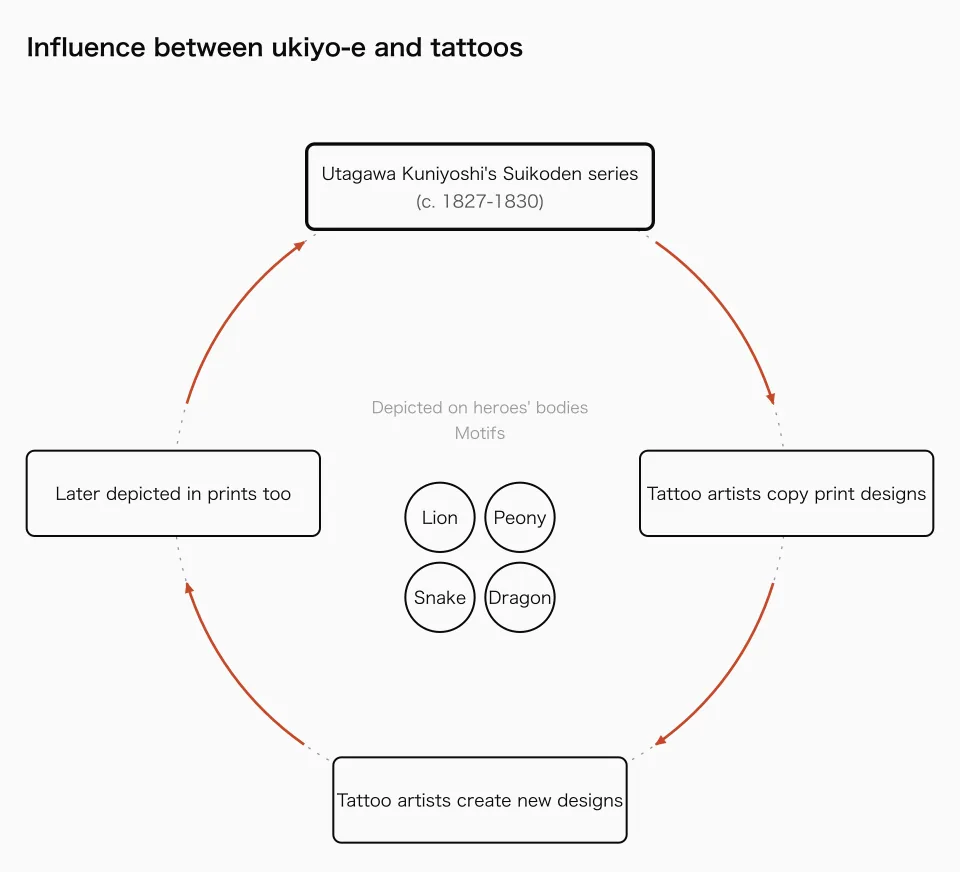
Some wabori motifs, karajishi among them, are said to be linked to Edo-period ukiyo-e. According to the Museum of Fine Arts, Boston, tattoo artists in early 19th-century Edo drew inspiration from the color woodblock prints of ukiyo-e [6]. The museum also explains that Japanese tattooing came to occupy an important place in urban popular culture in the early 19th century [7]. This spread is said to have been strongly influenced by the success of a woodblock print series by Utagawa Kuniyoshi, depicting Chinese martial heroes with elaborate tattoos [7].
Kuniyoshi (1797 to 1861) created his series "One Hundred and Eight Heroes of the Suikoden" around 1827 to 1830 [6]. Among today's tattoo artists, this body of work is still spoken of as the source of the fashion for large tattoo designs covering the body [6]. Kuniyoshi depicted lions, peonies, snakes, supernatural beings, and dragons on the bodies of these heroes [6]. According to another explanation from the Museum of Fine Arts, Boston, the original Suikoden text says nothing about what tattoo Yan Qing wore. Kuniyoshi gave him a lion among peonies, said to symbolize courage [8].
Tattoo artists did not simply copy print designs as they were. According to the Museum of Fine Arts, Boston, they copied print motifs and then created new designs of their own, which were in turn depicted in later prints [7]. Prints and tattoos influenced each other, and the designs were refined through this exchange. Karajishi, then, carries both a history as a guardian beast raised at temples and shrines, and a side linked, as some point out, to ukiyo-e culture.
Meanings You Can Carry in a Modern Karajishi Tattoo
The sources covered so far reveal several meanings layered onto karajishi over time: "protection" and "warding off evil" at temples, shrines, and the imperial court [2, 3, 4]; "power," like royal authority, found in Tang-dynasty Chinese patterns [3]; and "courage," as Kuniyoshi painted it on the bodies of his heroes [8]. There is also a 1649 votive painting, "Karajishi Among Peonies," held by the Metropolitan Museum of Art, which bears the names of eight donors. The upper part of the composition carries an inscription expressing a wish for its fulfillment [9]. This example shows that karajishi has also appeared in scenes where people prayed for their wishes to come true.
Which meaning you carry is up to you. Some people put in the wish for protection for themselves or their family, while others want to express valor and strength. What matters is choosing karajishi knowing that its meaning is not a tattoo's actual effect, but a symbol that history has nurtured. For the meaning of the peony often paired with karajishi, see our article dedicated to peony symbolism.
If you're thinking about getting karajishi, tell your artist what meaning you want to carry during your pre-session consultation. Whether you want it to look dignified as a guardian deity or dynamic and valiant changes how the face and composition are designed. Discussing where you want it placed, the size, and whether to pair it with other motifs will also help you settle on a design.
FAQ
Is karajishi an actual lion?
It's based on the lion, but it is not an actual lion itself. As it traveled from West Asia through China to Japan, its form changed, and it came to be depicted as a decorative, imagined beast.
Why is it called "kara" jishi?
Dictionaries explain that it's a word for foreign-born beasts, used in contrast to shishi, the term applied in Japan to animals like boar and deer. It's a name created to distinguish it from Japan's own shishi.
What's the difference between karajishi and komainu?
The Kyoto National Museum explains that the one with a single horn on its head is called komainu, and the one without is called the lion. The pairing of lion and komainu was devised in the Heian period, taking on the role of guarding the gods and Buddha at the entrances and halls of temples and shrines. Komainu exists as the partner placed alongside the lion in that pair. Karajishi, meanwhile, was also widely depicted on its own, as a motif for armor decoration, fusuma, and byobu paintings.
Does getting a karajishi tattoo ward off evil?
Karajishi has been treated as a symbol of warding off evil and protection at temples, shrines, and the imperial court. That said, this is a symbolic role, not an actual effect where the tattoo prevents misfortune. Some people choose the design simply to carry the feeling of a protective charm.
How is the wabori karajishi connected to ukiyo-e?
A connection to ukiyo-e has been pointed out. The Museum of Fine Arts, Boston explains that in early 19th-century Edo, tattoo artists drew inspiration from ukiyo-e woodblock prints. Utagawa Kuniyoshi painted lions, dragons, and peonies on the bodies of Suikoden heroes, and tattoo artists are said to have copied these print designs.
References
- [1] 奈良国立博物館. 狻猊. (奈良国立博物館, 2017). Link
- [2] 京都国立博物館. 特集陳列 獅子と狛犬. (京都国立博物館, 2015). Link
- [3] 伊東史朗. 文化財鑑賞の手引き 獅子―瑞獣と守護獣―. (文化庁, 2005). Link
- [4] ジャパンサーチ. 霊獣・想像上の動物. (ジャパンサーチ, 年不詳). Link
- [5] 小学館・平凡社. 唐獅子. (小学館『精選版 日本国語大辞典』、平凡社『世界大百科事典』, 年不詳). Link
- [6] Museum of Fine Arts, Boston. Tattoos in Japanese Prints. (Museum of Fine Arts, Boston, 年不詳). Link
- [7] Museum of Fine Arts, Boston. Under the Skin: Tattoos in Japanese Prints. (Museum of Fine Arts, Boston, 年不詳). Link
- [8] Museum of Fine Arts, Boston. Two Japanese Master Printmakers Go Head to Head in “Showdown! Kuniyoshi vs. Kunisada”. (Museum of Fine Arts, Boston, 2017). Link
- [9] 作者不詳. Ema (Votive Painting) of Chinese Lion and Peony Tree. (The Metropolitan Museum of Art, 1649). Link
Japanese tattoo in Tokyo
Turn Japanese tattoo history into a custom design
Explore traditional motifs, modern Japanese compositions, and the consultation process with our English-friendly Ueno studio.
Related Articles

The Meaning of Lotus Tattoos and How the Flower Appears in Wabori
Lotus tattoos are often described as a flower that "blooms pure from the mud." Yet this meaning shifts slightly depending on the source: Buddhist scripture, Japanese Buddhist art, and the Chinese essay "Ai Lian Shuo." Tracing these sources, this article looks at what the lotus means and the role the flower plays within wabori.
2026.11.02
What Do Wabori Motifs Mean? A Field Guide to Flowers, Dragons, Hannya, and Mythical Beasts by Category
What does the dragon represent? What does the hannya mask carry? Wabori (traditional Japanese tattoo) designs hold meanings passed down through kimono patterns, mythology, Noh theater, and ukiyo-e prints. This article sorts the main motifs into categories: flowers, dragons, snakes and koi, masks, mythical beasts, and background elements, so you can look up the meaning and origin traditionally tied to each one in a single line.
2026.10.19
Oni Tattoo Meaning vs. Hannya: Telling Them Apart by Horns and Fangs
Oni and hannya are both fearsome, horned faces, but they come from different places. Oni is a broad category shaped by beliefs about the dead and Buddhist influence, while hannya is one specific demon-woman mask used in noh theater. This article traces where each comes from, offers visual clues for telling them apart, and walks through how to decide which one to get tattooed.
2026.10.12