Ink as a Second Skin: The Tattooed Tradesmen of Old Japan
2026.06.27
In Edo and early Meiji Japan, tattoos were not only the mark of firemen. They covered the backs of grooms, porters, couriers, and laborers who worked half-dressed and wore ink as a workwear-like covering, as a sign of trade identity, and as plain proof of nerve. This article explores the working history behind those tattoos.
Introduction
Picture a summer street in old Edo. A groom trots beside a horse, stripped to a loincloth in the heat, and his back and arms are covered edge to edge in color: a dragon, waves, a scatter of flowers. He is a working man whose tattoos form part of his working appearance.
Most short histories of Japanese tattooing jump straight from woodblock prints to firemen to the yakuza. The firemen belong in the story, but they were not alone. A peer-reviewed history names the tattooed working classes as manual laborers, palanquin bearers, mail runners, and firefighters, and period photographs let us add horse grooms and boat crews to the picture [1][3]. In these trades, men often worked with little clothing, and full-body irezumi served as a kind of covering. Foreign observers could see the decorated skin as resembling a uniform.
Drawing on a peer-reviewed history and museum and library records, this article examines why men in these trades got tattooed, how treaty-port photographers portrayed them, and how an 1872 law targeted workers with exposed, tattooed skin. Some familiar stories about these workers are less well supported than others.
Why a working man wore ink
Start with the clothes, or the lack of them. The hard physical trades of the city, hauling, climbing, running, and minding horses, were done in heat and humidity with almost nothing on. A loincloth was the working uniform. That left a lot of bare skin, and decorated skin became a covering of sorts, a second layer that stood in for the robes a laborer could not work in [2][3].
The art these men wore did not come from nowhere. In the early 1800s the print artist Utagawa Kuniyoshi, who lived from 1797 to 1861, published a hugely popular series of woodblock prints showing the tattooed heroes of a Chinese outlaw saga known in Japan as the Suikoden. The prints helped launch a tattoo boom. In the downtown shitamachi districts, artisans and manual laborers had these fierce, righteous heroes recreated on their own bodies [1].
A sign of belonging, not just a decoration
Shared tattoo imagery could signal social belonging. It could signal a man's place in a rough, working-class masculine world, and it advertised a certain toughness. For the firemen the link was often drawn directly. By some accounts they wore thick padded coats called hikeshi banten, plain on the outside but elaborately decorated within, and after a fire they turned the coats inside out to show the design; their tattoos are said to have echoed that lining, and later commentary even suggests the markings could help identify a fireman's body if he died in the flames [4].
There was a bravado in it too. The scholar John Skutlin, summarizing the work of Margo DeMello, notes that in the West the tattoo became "a symbol of masculine bravado" when worn on soldiers and blue-collar workers; this article reads the working tattoos of old Edo in a similar register, since among men whose jobs were dangerous, ink could be a quiet claim of guts. The hero designs of the Suikoden carried an outlaw, anti-establishment charge, a sense of solidarity against the people in charge that ran like an undercurrent beneath the fashion [1].
The naked trades, one by one
Who wore ink, and why
| Trade | Why ink |
|---|---|
| Firemen (tobi) | Worked half-dressed in danger; ink was a badge of nerve |
| Rickshaw pullers (shafu) | Some worked nearly naked in Tokyo's summer heat |
| Palanquin bearers (kago) | Listed among tattooed workers in historical research |
| Couriers (hikyaku) | Ran long distances lightly clothed |
| Grooms and laborers | Stripped to work; ink served as a second skin |
The evidence varies by trade. The clearest statement comes from Skutlin, who writes that tattoos in this period "were still associated with the lower working classes," and lists them plainly: "manual laborers, palanquin bearers, mail runners, and firefighters" [1]. Around that core, period photographs and accounts fill in the rest.
Firemen and tobi
The Edo firefighters, the hikeshi, were folk heroes, prized for nerve and muscle, and they were among the best-known urban wearers of full-body tattoos [4]. Many doubled as tobi, the steeplejack-laborers who climbed scaffolding and tore down buildings to starve a fire of fuel. The fire brigades and the tobi overlapped, and so did their reputation for ink and bravado [3][4].
Grooms, or betto
The horse grooms, the betto, are the trade we can actually see, because foreign photographers loved to pose them. One early Western album caption claimed the custom of tattooing had passed from fishermen, who marked themselves to frighten sea creatures, to the bettoes who then took it up "merely from motives of vanity" [3]. That origin tale is folklore, but several surviving studio portraits of heavily tattooed grooms are real records of the practice [5][6].
Couriers, bearers, haulers
The fleet-footed couriers, the hikyaku or "mail runners," ran long relays half-dressed and are named among the tattooed trades [1]. So are the palanquin bearers who carried people in a kago or norimono, and the laborers who pulled heavy carts and worked the docks and building sites [1]. A caption on one Felice Beato photograph even describes a boat crew as "sturdy, well-knit fellows" whose bodies were often decorated with "well drawn and nicely coloured" tattoos [3].
Rickshaw pullers
The rickshaw arrived only at the start of the Meiji era, around 1869 to 1870, then spread fast. According to later historical summaries, Tokyo already had roughly 56,000 of them by 1872 [7]. The pullers, the shafu, ran in the summer heat in little more than a loincloth at first, and the histories of the Meiji ban single them out by name, alongside porters, as the visibly tattooed workers whose bare, inked bodies the government found embarrassing [1][7].
How the West saw them: the Yokohama photographs
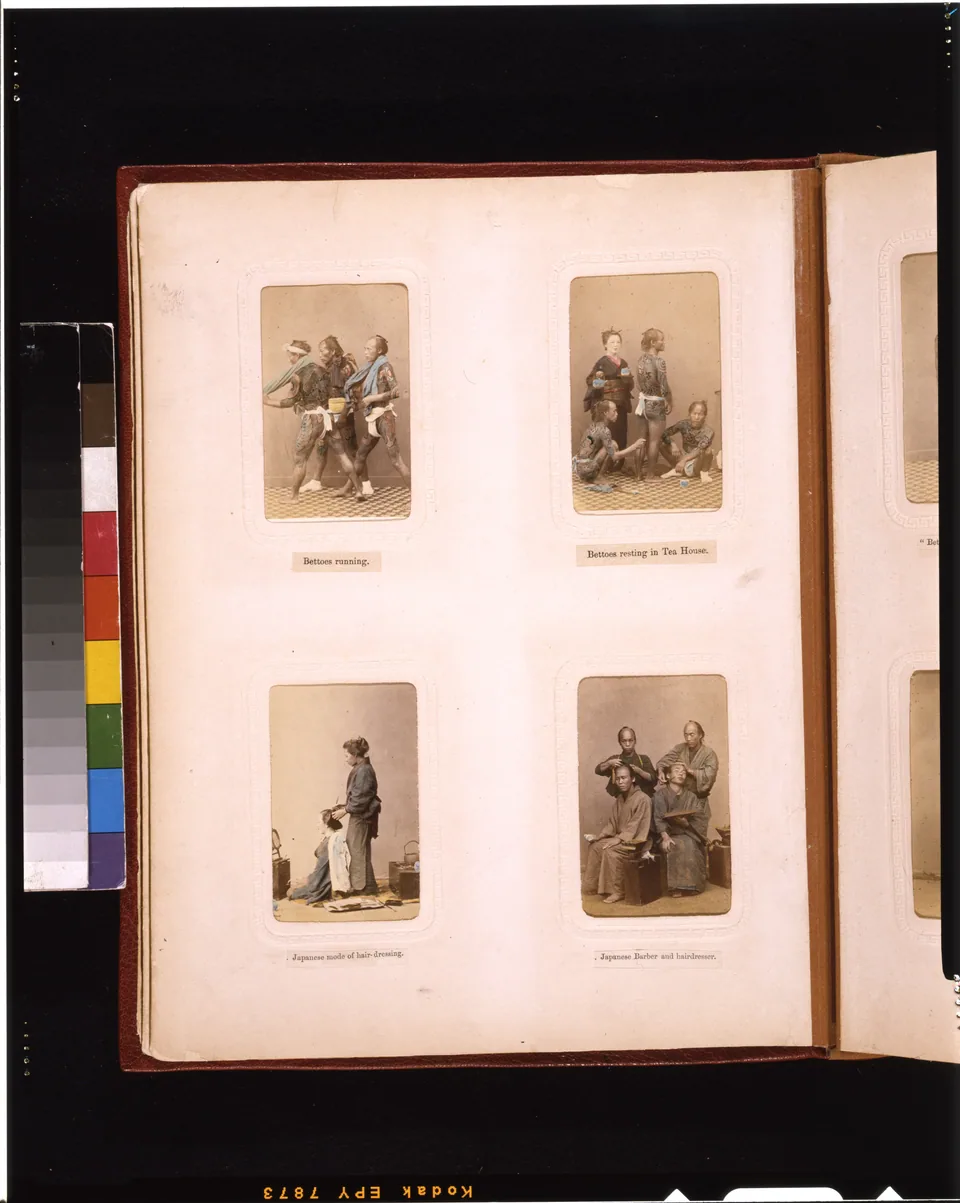
Much of what we can still see of these tattooed workers we owe to a peculiar industry that grew up in the treaty port of Yokohama: souvenir photography for foreigners, the so-called Yokohama-shashin.
The pioneer was Felice Beato, a naturalized British photographer who lived from about 1833 to 1909. He arrived in Japan in 1863 and settled in Yokohama, which had opened as a treaty port in 1859, and he worked there for twenty-one years [2]. Already famous for war photography in Crimea and China, Beato turned his Yokohama studio toward the tourist trade, producing hand-colored albumen prints of landscapes, "types," and scenes of daily life. He gathered them into an album, Photographic Views of Japan with Historical and Descriptive Notes, published around 1869, with English captions written by James W. Murray and others [2].
Studio "types," not snapshots
Beato's studio portraits are best read as staged "types" rather than snapshots, a gallery of Japanese figures assembled for Western buyers: the merchant, the painter, the groom. The captions, the MIT scholar Alona C. Wilson notes, "contain many factual errors that reveal the rudimentary level of foreign knowledge of Japan" at the time [2]. So the tattooed groom in a Beato print is a real record of a real practice, but he is also a posed product, sold to confirm what foreigners expected to find.
Beato was not the only one. When he closed his business in 1877 he sold his studio and negatives to Baron Raimund von Stillfried, whose firm kept printing and selling such images, and the trade in tattooed-groom portraits carried on under other names well into the Meiji years [2]. The result is an unusually rich visual archive of a labor history that left few written records of its own.
Sailors in the ports
Traffic went both ways. The same treaty ports where foreigners photographed tattooed grooms were also places where foreign visitors got tattooed themselves. Japanese tattoo masters had a high reputation abroad, and foreign soldiers and sailors who came through the ports were among those who sought them out, which helped keep tattooists busy in the foreign quarters [8].
The 1872 ban that targeted the naked trades
The Meiji government took a different view of tattooing. When the Meiji government took power in 1868 it set out to look modern and "civilized" to the Western nations whose warships had forced the country open. Tattoos were a problem for that image, and the reason was specifically the working class.
Skutlin lays out the logic. The government decided tattooing would look "barbaric" if left alone, "since rickshaw pullers and porters, many of whom worked nearly naked in the sweltering heat and humidity of Tokyo summers, were often colorfully adorned with highly visible tattoos." So in 1872 it passed a law banning both the act of tattooing and the public display of tattoos, with prison for tattooists and seizure of their tools [1].
A law about bare skin
The key law was not aimed at tattoos alone. It was a misdemeanor ordinance, the Ishiki kaii jorei, and Skutlin, drawing on the anthropologist Satsuki Kawano, notes that it also forbade commoners, especially women, from appearing in public partly dressed, and that it banned mixed bathing. Ordinary bodies became the target of new rules about what could be shown in public [1].
That is why this ban landed so hard on the naked trades. A tattooed laborer in the street now committed what Skutlin calls a "double transgression": first by being undressed, and second by wearing a marking the new rules deemed barbaric [1]. The very thing that made ink useful to these men, that they worked with their skin on show, is exactly what the law set out to cover up.
The ban did not erase the practice. It pushed irezumi out of sight and forced its masters to work underground, and the art's public reputation slid toward the disreputable. The legal ban on tattooing was not lifted until the years just after the Second World War, dated to 1947 by Skutlin and to 1948 under the Occupation by other accounts [1][8].
The open door for foreigners
There was a notable exception. The crackdown fell on Japanese subjects, and exceptions were sometimes made for foreigners. In some treaty-port contexts Japanese tattooists were allowed to keep working on visitors, so that even as the art went into hiding at home it kept a legal, paying life on the skin of outsiders [9].
Japanese tattoo masters had a high reputation abroad, and visitors sought them out [8]. The best-documented clients were royal. The Royal Collection Trust records that at least three British royals were tattooed in Japan in these years: Prince Alfred and the young princes Albert Victor and George. Prince Alfred, Duke of Edinburgh, received an artist at his Tokyo guesthouse in 1869 and had a writhing dragon put on his right arm [9].
The most famous case is the future King George V. As a teenage naval cadet aboard HMS Bacchante in 1881, he and his brother Prince Albert Victor were tattooed during their visit to Japan, along with much of the crew. In his diary George described an artist who could complete "a large dragon in blue and red writhing all down the arm in about three hours" [9].
Popular articles often name the celebrity tattooist Hori Chiyo as the man who inked the princes. The Royal Collection Trust, working from the records, says the artist was "probably Karakusa Gonta, the finest tattooist of the time" [9]. The royal tattoos are well documented; the exact hand that made them is less certain, and you should treat confident single names with care. Other foreign royals are sometimes added to these lists, including the future Tsar Nicholas II, who is said to have received irezumi, but those attributions are weaker, so we leave them as reported rather than confirmed [8].
What is solid and what is folklore
Much of this history survives in foreign accounts and folk memory, which vary in reliability.
Well documented: tattooing was well attested among several lower working trades of Edo and early Meiji, the Suikoden prints of Kuniyoshi helped drive a tattoo boom, firemen were closely tied to ink, the 1872 misdemeanor ordinance banned both tattooing and public undress, and that ban hit visibly tattooed workers like rickshaw pullers and porters. These rest on a peer-reviewed history and the scholars it cites [1].
Treaty-port photographs of tattooed grooms and laborers survive in museum and library collections, and the Beato studio and its successors sold such photographs to tourists [2][6].
More folklore than fact: the neat origin tale that grooms inherited tattooing from shark-fearing fishermen, which appears in a period album caption and should be read as a story foreigners were told [3]. Also shaky are the sweeping celebrity claims, such as a single named master who supposedly tattooed every visiting prince [9]. The broad historical pattern is well supported, but some individual stories remain uncertain.
Why this labor history is worth a traveler's time
For a visitor curious about Japanese tattooing, this older layer is the part most guidebooks skip, and it changes the picture. The nineteenth-century decorative bodysuit was not simply a criminal badge. For some workers it could function like visible workwear and a sign of belonging, worn openly by the men who pulled the carts, ran the mail, climbed the scaffolds, and minded the horses.
It also explains the strange double life the art still leads in Japan. The association between tattoos and the underworld developed through several historical changes, including penal tattooing and later restrictions on decorative tattooing. The 1872 ban helped drive a once-open custom into hiding, while tattooists continued to work on foreign visitors in some treaty-port settings [1][9]. Knowing this makes the modern mood easier to read, including why some baths and pools still post their own rules.
Evis works with visitors who want to get tattooed during their trip to Japan. For those considering a traditional wave-and-dragon design, the workers who once wore these images are part of its history. We share that history alongside the art, including the social conditions in which it developed.
References
- John Skutlin. Fashioning Tattooed Bodies: An Exploration of Japan's Tattoo Stigma. Asia Pacific Perspectives, Vol. 16, No. 1, Center for Asia Pacific Studies, University of San Francisco, 2019, pp. 4-33. https://jayna.usfca.edu/asia-pacific-perspectives/pdfs/skutlin_app_16_v_1_4.19.19_cc_2018_4-33_.pdf
- Alona C. Wilson. Felice Beato's Japan: People. MIT Visualizing Cultures, 2010. https://visualizingcultures.mit.edu/beato_people/fb2_essay.pdf
- Alona C. Wilson. Felice Beato's Japan: People (caption discussion of boatmen and laborers). MIT Visualizing Cultures, 2010. https://visualizingcultures.mit.edu/beato_people/fb2_essay.pdf
- Kintaro Publishing. The Tattooed Firefighters of Edo. Kintaro Publishing, 2022. https://kintaro-publishing.com/blogs/news/the-tattooed-firefighters-of-edo
- Museum of Fine Arts, Boston. Betto or Groom (Felice Beato, c. 1863-1867), catalog entry. Museum of Fine Arts, Boston. https://collections.mfa.org/objects/544297
- Felice Beato. Studio portraits of Japanese tattooed "bettoes" (horse grooms), a mother carrying child on her back, and two young sisters. Library of Congress, Prints and Photographs Division, LOT 4339, LCCN 2011649861, between 1863 and 1877. https://www.loc.gov/item/2011649861/
- Kjeld Duits. The "Human Horses" of the Rickshaw. OldPhotosJapan.com, 2022. https://www.oldphotosjapan.com/photos/896/history-of-the-japanese-rickshaw-jinrikisha-vintage-photography
- Yamamoto Yoshimi. "Irezumi": The Japanese Tattoo Unveiled. Nippon.com, 2017. https://www.nippon.com/en/views/b06701/
- Royal Collection Trust. Royal Tattoos (Japan: Courts and Culture). Royal Collection Trust. https://www.rct.uk/collection/exhibitions/japan-courts-and-culture/the-queens-gallery-buckingham-palace/features/royal-tattoos
FAQ
Which trades in old Japan wore tattoos besides firemen?
A peer-reviewed history lists the tattooed working classes plainly as manual laborers, palanquin bearers, mail runners (couriers), and firefighters [1]. Period photographs and accounts add horse grooms (betto), boat crews, and Meiji-era rickshaw pullers (shafu). These were physical trades done half-dressed, so tattoos worked as a kind of covering and a sign of trade identity [1][3][7].
Why did half-naked laborers get tattooed?
Their work was done in heat in little more than a loincloth, so decorated skin acted as a second layer of covering. Ink could also signal a man's place in a rough, working-class world and advertise toughness. Many designs copied the tattooed outlaw heroes of the Suikoden, popularized by Utagawa Kuniyoshi's prints, which carried a bravado and an anti-establishment charge [1][2].
What was the 1872 Meiji tattoo ban, and who did it target?
In 1872 the Meiji government banned both giving and displaying tattoos. The key law was a misdemeanor ordinance, the Ishiki kaii jorei, which also outlawed public undress and mixed bathing. Because tattooed laborers worked with bare skin on show, they committed a double offense, undress plus a marking deemed barbaric. The aim was to look civilized to Western powers. The ban was lifted around 1947 to 1948 [1].
Who were the tattooed grooms in old Japanese photographs?
They were betto, horse grooms, posed by treaty-port photographers like Felice Beato for souvenir albums sold to foreigners. The Library of Congress holds Beato studio portraits of tattooed bettoes dated between 1863 and 1877 [6]. Read them with care: the men and the practice are real, but the images were staged "types" for Western buyers, and their captions contain errors [2].
Did foreigners really get tattooed in Japan during the ban?
Yes. The crackdown fell on Japanese subjects, and exceptions were sometimes made for foreigners, so tattooists kept working on visitors in some treaty-port contexts [9]. The Royal Collection Trust documents British royals tattooed in Japan, including Prince Alfred in 1869 and the future King George V as a naval cadet in 1881, whose diary describes a dragon "writhing all down the arm" [9]. Some celebrity attributions, such as the exact artist, are uncertain [9].
Japanese tattoo in Tokyo
Turn Japanese tattoo history into a custom design
Explore traditional motifs, modern Japanese compositions, and the consultation process with our English-friendly Ueno studio.
Related Articles
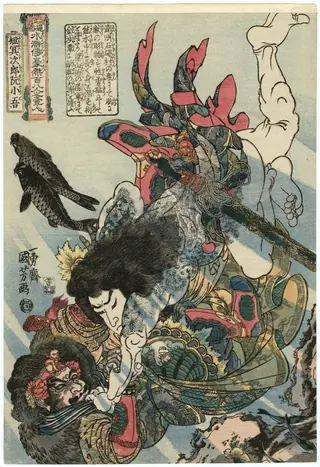
Reading Edo Tattoo Through Tanizaki's "The Tattooer"
In 1910 a young Tanizaki published "Shisei," a short story about a tattooer who inks a spider on a sleeping girl. The fictional artist draws on the world of Edo horimono. Its history helps explain the story, though documented events and later traditions need to be distinguished.
2026.06.27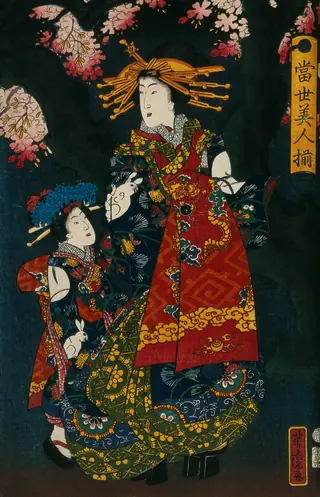
When a Tattoo Meant Forever: Ink and Japan's Pleasure Quarters
Tattoos in Japan have signaled devotion as well as ties to the outlaw world. In the pleasure quarters of the Edo period, courtesans and their patrons inked a name plus the character for life into the skin as a private oath. This article explores the social history of that mark and the conditions in which it was made.
2026.06.27
What the Snake Carries in Japanese Tattooing, from the God of Mount Miwa to the Serpent of Dōjōji
Before it was a monster, the snake was a god. In the Nihon Shoki the god of Mount Miwa appears as a small snake; the water spirit that brings rain is called the mizuchi; and the woman of Dōjōji becomes a serpent and burns the bell. Chronicles, Chinese texts, Noh and Edo serial fiction help explain these meanings in Japanese tattooing, including how the white snake became associated with wealth.
2026.09.11